CRM ROI is no longer just about proving that a platform was worth the subscription cost. In 2026, businesses expect their CRM investment to improve sales performance, increase team efficiency, reduce manual work, and create more predictable revenue across the customer lifecycle. Measuring return correctly means looking beyond software price and understanding how the CRM affects operations, conversion, retention, and long-term growth.
This guide explains how to calculate return on investment for CRM, which metrics matter most, what hidden costs reduce profitability, and how to increase CRM-driven revenue without increasing complexity. The goal is to help businesses evaluate CRM performance with a practical, profit-focused approach instead of relying on assumptions or surface-level reporting.
What Is CRM ROI and Why It Matters for Your Business in 2026
CRM ROI refers to the measurable business return generated from the money, time, and resources invested in a customer relationship management system. In simple terms, it answers one practical question: is the CRM helping the business produce more value than it costs to implement, maintain, and use?
That return can appear in different ways. For some companies, it comes from higher sales revenue because leads are tracked better and follow-up is faster. For others, it comes from lower operational costs because the CRM reduces manual work, improves team productivity, and automates repetitive tasks. In many cases, the real value comes from both sides at once: more revenue and better efficiency.
In 2026, measuring return on CRM investment matters more because CRM platforms now sit closer to core business operations than they did a few years ago. They are no longer used only as contact databases. Modern CRMs influence lead management, pipeline visibility, forecasting, customer support coordination, marketing automation, retention, and reporting. That means the CRM is often tied directly to revenue decisions, customer experience, and process efficiency across multiple teams.
This makes CRM ROI a strategic metric, not just a finance exercise. A business that understands CRM return can make better decisions about software spend, team adoption, workflow design, and automation priorities. Without that visibility, companies often keep paying for tools, features, and integrations that look useful but do not create measurable business impact.
It also matters because CRM costs have become more layered. The subscription itself is only one part of the investment. Businesses also spend on onboarding, customization, integrations, internal training, administration, data cleanup, and process changes. If leaders evaluate the CRM only by license cost, they often miss the real economics behind the platform. Measuring ROI helps reveal whether the system is producing meaningful results relative to its full cost.
Another reason this matters in 2026 is that many businesses now depend on CRM automation to scale without adding headcount at the same pace. If the CRM helps sales reps close faster, support teams work with better context, and managers make decisions using cleaner data, the return can be substantial. But if adoption is weak or workflows are poorly configured, the same CRM can become an expensive layer of complexity with little payoff.
For growing companies, CRM ROI also helps separate activity from actual performance. A team may be logging contacts, updating pipelines, and generating reports, but that does not automatically mean the CRM is driving results. The real test is whether the system improves conversion rates, sales velocity, retention, productivity, or customer value in a measurable way.
At a business level, tracking CRM ROI matters because it creates accountability. It forces teams to connect software usage with outcomes such as revenue growth, reduced sales friction, shorter response times, better forecasting, or lower administrative workload. That makes it easier to justify investment when the CRM is working and easier to fix the setup when it is not.
In practical terms, a CRM system matters in 2026 not because every company is expected to have one, but because businesses that use it well gain a stronger advantage in efficiency, visibility, and execution. Measuring ROI is what shows whether the CRM is actually becoming a profit driver instead of just another software expense.
Key Metrics to Measure CRM ROI: What to Track and Why
To measure CRM ROI correctly, businesses need to track more than software cost and total sales. The real return of a CRM system appears through a mix of revenue growth, efficiency gains, pipeline improvement, and customer value. If the wrong metrics are used, teams may think the CRM is performing well when it is only creating more activity, not better results.
One of the most important metrics is lead-to-customer conversion rate. This shows whether the CRM is helping the team move prospects through the funnel more effectively. If conversion rates improve after better pipeline management, automation, lead scoring, or follow-up workflows are introduced, that is a strong sign the CRM is contributing to real business outcomes rather than just storing contact data.
Another core metric is sales cycle length. A good CRM should help reduce the time it takes to move from first contact to closed deal by improving visibility, reminders, task automation, and handoffs between teams. A shorter sales cycle usually means the CRM is helping sales teams act faster, prioritize better, and remove friction from the buying process. That has a direct impact on both revenue timing and operational efficiency.
Average deal size is also important because a well-used CRM can improve how teams identify upsell opportunities, qualify leads, personalize outreach, and focus on better-fit accounts. If average contract value increases after CRM adoption or optimization, that often reflects stronger sales execution supported by better customer and pipeline data.
Businesses should also track sales team productivity. This can be measured through metrics such as deals closed per rep, leads handled per rep, follow-up completion rate, or time spent on administrative work versus selling time. One of the biggest promises of CRM automation is that it reduces manual effort. If reps are still wasting time on data entry, poor handoffs, or fragmented workflows, ROI will remain lower than it should be.
On the customer side, customer retention rate and customer lifetime value are key ROI indicators. CRM value does not stop at the first sale. A strong CRM setup can improve retention by supporting better onboarding, smarter follow-up, service visibility, and more relevant account management. If customer relationships last longer and produce more revenue over time, the CRM is creating long-term return beyond acquisition.
Another high-value metric is forecast accuracy. In many businesses, one of the hidden benefits of a CRM is better decision-making. When pipeline data is updated consistently and opportunity stages are managed properly, leaders can forecast revenue more accurately and allocate resources more effectively. Better forecasting does not always show up as an immediate revenue spike, but it has strong strategic value because it improves planning and reduces costly misjudgments.
Customer acquisition cost is another useful metric when measuring return on CRM investment. If the CRM improves lead quality, speeds up qualification, and helps sales teams focus on high-intent opportunities, the cost to acquire each customer can decrease over time. This matters especially for businesses investing heavily in paid traffic, outbound sales, or multiple marketing channels.
Support-related metrics can also matter, especially when the CRM connects sales and service workflows. Businesses may track first response time, ticket resolution speed, or customer satisfaction trends if support efficiency is part of the CRM’s role. Faster service and better customer visibility often reduce churn and strengthen retention, which indirectly increases ROI.
Finally, businesses should track CRM adoption rate and data quality metrics. Even the best platform cannot produce strong ROI if teams do not use it consistently or if records are incomplete and unreliable. Metrics such as active usage, record completeness, workflow usage, and duplicate rate help reveal whether poor ROI is caused by the software itself or by weak execution.
The best way to measure CRM ROI metrics is to combine financial outcomes with operational indicators. Revenue, retention, and deal value show business impact. Productivity, adoption, and process metrics show whether the CRM is actually driving that impact. Together, these measurements give a much clearer picture of whether the CRM is creating real return or simply adding software cost.
How to Calculate CRM ROI: Formula, Variables, and Real Examples
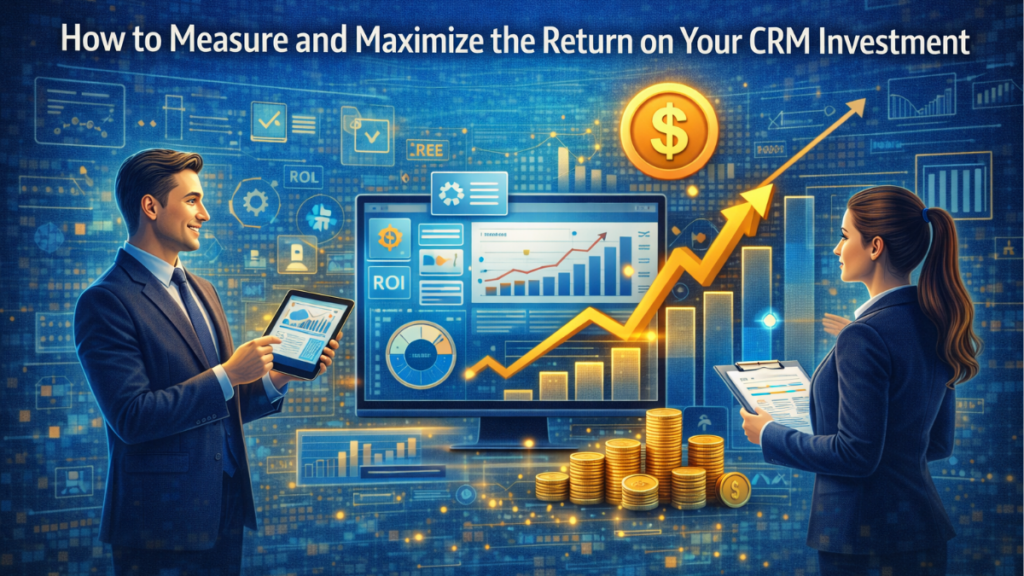
To calculate CRM ROI, the goal is to compare the total value the CRM system generates against the total cost of adopting and running it. The standard formula is straightforward:
CRM ROI = ((Total Return – Total CRM Cost) / Total CRM Cost) x 100
This gives the return as a percentage. If the result is positive, the CRM is generating more value than it costs. If the result is negative, the business is spending more than it is getting back. The challenge is not the formula itself, but defining the right variables so the calculation reflects real business performance instead of a rough estimate.
The first variable is total return. In CRM terms, this usually includes additional revenue gained, cost savings created, or both. Revenue gains may come from higher conversion rates, larger deal sizes, faster follow-up, better retention, or improved upsells. Cost savings may come from reduced manual work, lower administrative time, shorter sales cycles, better lead prioritization, or fewer lost opportunities caused by poor visibility. A strong calculation includes only the gains that can reasonably be linked to CRM usage or CRM-driven process improvements.
The second variable is total CRM cost. This should include more than the monthly subscription. A realistic CRM ROI calculation usually includes software licenses, onboarding costs, implementation support, integrations, staff training, customization, internal admin time, data migration, maintenance, and any external consultants or developers involved. If these costs are ignored, ROI looks artificially high and becomes less useful for decision-making.
A practical way to structure the calculation is to evaluate ROI over a fixed period, such as 6 months, 12 months, or 24 months. This matters because many CRM benefits build over time. In the first months, costs are often front-loaded due to setup and training. Later, returns may improve as adoption, automation, and data quality get stronger. Measuring ROI too early can make a good CRM investment look weak when it is still in the implementation phase.
Example 1: Small B2B company. A company spends $12,000 over one year on CRM licenses, onboarding, staff training, and basic integrations. During that same year, it estimates the CRM helped generate $35,000 in additional profit through better lead follow-up and increased close rates. The calculation would be:
CRM ROI = (($35,000 – $12,000) / $12,000) x 100 = 191.7%
In this case, the CRM delivered a return of about 192%. That means the company earned nearly twice its CRM investment back in measurable value beyond cost.
Example 2: Sales efficiency and labor savings. A company invests $20,000 per year in its CRM. After automating lead assignment, follow-up reminders, and reporting, the sales team saves around 15 hours per week. If those hours are worth $35 per hour, the yearly time savings equal $27,300. If better visibility also helps generate $18,000 in additional profit from improved conversions, total return becomes $45,300.
CRM ROI = (($45,300 – $20,000) / $20,000) x 100 = 126.5%
This example shows why CRM return on investment should include both revenue impact and efficiency gains. In many businesses, the CRM creates value not only by helping close more business, but also by reducing wasted time across teams.
Example 3: Early-stage underperformance. A business spends $18,000 in the first year on CRM implementation, but due to poor adoption and limited workflow setup, it can only identify $10,000 in measurable gains by year-end.
CRM ROI = (($10,000 – $18,000) / $18,000) x 100 = -44.4%
This does not always mean the CRM was the wrong decision. It may mean the rollout is incomplete, training is weak, or teams are not using the platform well enough yet. A negative first-year ROI often points to execution problems, delayed adoption, or measuring too early rather than proving the CRM has no long-term value.
To make the calculation more accurate, businesses should separate gross revenue from profit contribution whenever possible. If a CRM helps generate more sales, the return should ideally reflect the profit from those sales, not just top-line revenue. This produces a more realistic picture of how much financial value the CRM is actually creating.
It is also useful to compare ROI before and after specific CRM improvements. For example, a business may calculate CRM ROI before adding automation, then recalculate it after improving lead routing or pipeline visibility. This helps identify which changes are producing the highest return and where future optimization efforts should focus.
In practical terms, the best CRM ROI formula is not the one that looks most impressive. It is the one that includes real costs, realistic gains, and a time frame long enough to reflect how the CRM is actually being used. When calculated this way, ROI becomes a decision tool for improving performance, not just a number used to justify software spend.
Hidden CRM Costs That Affect Your ROI (And How to Control Them)
Many businesses underestimate CRM ROI because they calculate return against the subscription price alone. In reality, the total cost of a CRM system is often much higher once implementation, operations, and inefficiencies are included. These hidden costs can quietly reduce profitability, especially when the platform is overbuilt, underused, or poorly aligned with real workflows.
One of the most common hidden costs is implementation time. Even when a CRM looks simple on paper, setup usually requires internal planning, process mapping, data migration, permissions, testing, and team coordination. That time has a real cost because employees are spending hours on deployment instead of revenue-generating work. The best way to control this is to keep the first rollout narrow, prioritize only the workflows that matter most, and avoid trying to customize everything at once.
Another major cost is training and adoption. A CRM does not produce value just because it is installed. Teams need to understand how to use it correctly, when to update records, which workflows to follow, and how the system supports their daily work. If adoption is weak, the business pays for the software and still loses productivity because employees work around the CRM instead of through it. To control this, training should be role-specific, practical, and tied to clear operational use cases rather than generic product tours.
Data migration and cleanup are also underestimated in many CRM projects. Importing messy, duplicated, outdated, or incomplete records into a new platform creates long-term reporting and automation problems. Poor data quality can damage lead scoring, segmentation, forecasting, and customer follow-up, which lowers both efficiency and revenue performance. The most effective way to control this cost is to clean data before migration, define field standards early, and create rules that prevent duplicate or low-quality records from growing again.
Another hidden cost comes from over-customization. Businesses often add too many custom fields, workflows, pipeline stages, integrations, and permissions before proving that those changes are necessary. This increases setup cost, maintenance burden, and user confusion. It can also make future updates more difficult. A better approach is to start with the simplest system that supports the business process, then add complexity only when it creates measurable value.
Integration costs can also reduce return on CRM investment more than expected. Connecting the CRM to email platforms, support systems, forms, calendars, analytics tools, ecommerce platforms, or internal databases often requires paid connectors, technical support, or ongoing maintenance. If those integrations break or require frequent manual fixes, the CRM becomes more expensive over time. To control this, businesses should prioritize only high-impact integrations and choose tools with reliable native connections whenever possible.
There is also a hidden cost in administrative overhead. A CRM that requires constant manual updates, report corrections, workflow troubleshooting, or field management consumes internal resources every month. This cost is easy to ignore because it is spread across teams, but it directly affects ROI. One way to reduce it is to automate repetitive updates, simplify pipelines, and assign clear ownership for CRM governance instead of letting maintenance become everyone’s scattered responsibility.
Feature bloat and unused licenses are another common drain on ROI. Many companies pay for advanced tiers, premium modules, or large seat counts they do not fully use. Over time, this creates software waste that can be significant, especially in larger teams. Businesses should audit actual usage regularly, remove inactive users, review whether premium features are producing real outcomes, and downgrade where complexity is not justified.
A less visible but equally important cost is workflow inefficiency caused by poor setup. If the CRM creates extra clicks, duplicate work, unclear stages, or bad handoffs between teams, employees lose time every day. That lost productivity is a real financial cost, even if it does not appear as a line item on an invoice. The fix is to evaluate the CRM from the user’s point of view and redesign workflows around speed, clarity, and operational usefulness.
Another factor that hurts ROI is low-quality reporting. When dashboards are inaccurate because data is incomplete or fields are inconsistent, managers make weaker decisions about forecasting, staffing, lead prioritization, or pipeline health. That creates indirect costs that are harder to quantify but still meaningful. Strong reporting standards, clean field logic, and consistent usage habits are essential if the CRM is expected to support profitable decision-making.
In practical terms, hidden CRM costs are usually not caused by the platform alone. They come from complexity without discipline, software without adoption, and automation without operational clarity. The businesses that protect CRM ROI best are the ones that keep implementation focused, control unnecessary complexity, clean their data, and review ongoing software value with the same seriousness they apply to any other investment.
How CRM Automation and Efficiency Directly Impact ROI
CRM automation improves ROI by helping businesses generate more output without increasing effort at the same pace. Instead of relying on teams to manage every follow-up, update, reminder, assignment, and report manually, the CRM system handles repetitive processes in the background. This reduces wasted time, improves consistency, and allows sales, marketing, and support teams to focus on higher-value work.
One of the most direct ways automation affects CRM ROI is through time savings. Sales reps often lose hours each week to administrative work such as logging activities, updating deal stages, assigning leads, scheduling reminders, or sending repetitive follow-up messages. When these tasks are automated, teams spend more time on conversations, negotiations, and revenue-generating actions. Even small productivity gains per employee can create a meaningful financial return over time.
Automation also improves speed to action, which has a direct impact on revenue. A lead that receives an immediate follow-up is more likely to engage than one that waits hours or days for a response. CRM workflows can automatically assign leads, trigger email sequences, notify the right rep, and move contacts into the correct pipeline stage. This reduces lag across the funnel and helps businesses act while buyer intent is still high.
Another important factor is process consistency. Manual workflows depend heavily on individual habits, which often leads to missed tasks, incomplete records, and uneven execution across teams. Automation applies the same logic every time. Leads are routed using the same criteria, reminders are sent on schedule, stages are updated consistently, and follow-up actions happen even when teams are busy. That reliability improves operational performance and protects revenue opportunities that might otherwise be lost through human error.
Efficiency also affects ROI by lowering the operational cost of growth. Without automation, increased lead volume, more customers, or larger sales pipelines usually require more staff to handle the workload. With a well-configured CRM, businesses can scale much further before needing additional headcount. That means the cost per lead managed, deal processed, or support case handled can decline as the business grows, which strengthens profitability.
CRM automation also improves data quality, which indirectly but powerfully affects ROI. Automated field updates, form syncing, pipeline rules, and task tracking reduce the chance of incomplete or inconsistent records. Better data leads to more accurate forecasting, better segmentation, smarter prioritization, and stronger reporting. When teams trust the data inside the CRM, they make faster and better decisions, which improves both efficiency and financial performance.
Another direct impact comes from workflow visibility. Efficient CRM systems make it easier to see where leads are getting stuck, which reps are overloaded, which stages are slowing deals down, and which activities are not producing results. That visibility helps managers fix bottlenecks before they become expensive. In this sense, CRM efficiency does not only save time. It also reveals where revenue is leaking and where process improvements will create the highest return.
Automation can also increase ROI through better customer retention. For example, CRM workflows can trigger onboarding emails, renewal reminders, account check-ins, support follow-ups, and upsell sequences at the right time. These automations help businesses stay proactive instead of reactive, which improves customer experience and reduces the risk of churn. Since retaining customers is often cheaper than acquiring new ones, this kind of efficiency can produce strong long-term return.
A simple example shows the effect clearly. If a sales team of five reps saves five hours per week each through automation, that creates twenty-five hours of recovered time every week. If that time is redirected into calls, demos, and active deal management, the CRM is not just saving labor. It is increasing selling capacity without increasing payroll. When multiplied across months, this becomes one of the clearest ways CRM efficiency turns into measurable ROI.
In practical terms, the connection is straightforward: automation reduces manual effort, efficiency increases output, and both improve the financial return of the CRM investment. The businesses that get the highest ROI are usually not the ones with the most features. They are the ones that automate the right tasks, simplify execution, and make their teams more productive without adding unnecessary complexity.
How to Use CRM Data to Improve Sales Performance and Revenue
CRM data becomes valuable when it helps sales teams make better decisions, prioritize the right opportunities, and act with better timing. A CRM system should not function only as a database of contacts and deals. Its real role is to turn customer and pipeline information into clearer actions that improve sales performance and increase revenue.
One of the most effective uses of CRM data is better lead prioritization. Not all leads deserve the same speed, effort, or sales approach. By tracking data such as source, industry, company size, budget signals, product interest, engagement level, and previous interactions, businesses can identify which leads are most likely to convert. This helps sales reps focus first on higher-value opportunities instead of spreading time evenly across the entire pipeline.
CRM data also improves follow-up timing. Revenue is often lost not because a lead was bad, but because the response came too late or lacked relevance. When the CRM shows recent page visits, email engagement, demo requests, past conversations, or pipeline movement, reps can follow up with better context and at the right moment. That increases the likelihood of meaningful conversations and reduces wasted outreach.
Another important use is improving pipeline management. A CRM makes it easier to see where deals are slowing down, which stages have the highest drop-off, and which opportunities are inactive for too long. This gives managers and reps a more accurate view of what needs attention. Instead of relying on intuition, they can use CRM data to identify stalled deals, clean the pipeline, and focus effort where revenue is still recoverable.
Sales forecasting is another area where CRM data directly impacts revenue decisions. When opportunity stages, deal values, win rates, and sales activity are tracked consistently, businesses can forecast more accurately and plan around real pipeline health. Better forecasting helps teams allocate time, hiring, budget, and outreach capacity more effectively. It also reduces the risk of making growth decisions based on inflated or outdated assumptions.
CRM data can also reveal which actions drive stronger conversion rates. For example, businesses can compare close rates by lead source, campaign type, sales rep activity, product category, or deal size. This makes it easier to see whether revenue growth is coming from the right channels and where sales effort is being wasted. Once those patterns are visible, teams can invest more in high-performing segments and improve or remove low-performing ones.
Another strong use case is sales personalization. When reps can see the customer’s history, pain points, product interest, previous objections, and interaction timeline, their conversations become more relevant. Personalization does not only improve the buying experience. It also increases the chance of moving deals forward because the outreach reflects the customer’s real situation instead of sounding generic. Better relevance often leads to better response rates and stronger deal progression.
CRM reporting also helps improve rep performance by showing what top performers do differently. Businesses can analyze activity volume, stage progression, average response times, win rates, and deal size by rep or team. This helps uncover repeatable patterns behind strong performance and makes coaching more practical. Instead of giving general advice, managers can use actual CRM data to improve execution where it matters most.
Revenue growth also depends on using CRM data beyond new acquisition. Existing customer records can reveal upsell opportunities, renewal timing, product usage patterns, service issues, or account expansion potential. When businesses use CRM insights to identify customers who are ready for an upgrade or need proactive attention, they create additional revenue without depending only on new leads.
To make this work, the data inside the CRM has to be clean, structured, and consistently used. Poor field discipline, outdated pipeline stages, missing activity logs, and duplicate records weaken every downstream decision. A company cannot improve sales revenue with CRM data if the system is filled with incomplete or unreliable information. Data quality is what turns reporting into actionable intelligence.
In practical terms, the best way to use CRM data for sales is to connect it to daily execution. Prioritize better leads, follow up faster, identify stalled opportunities, personalize outreach, forecast more accurately, and uncover revenue patterns across the funnel. When that happens, the CRM stops being a passive record system and becomes an active tool for improving performance and driving growth.
CRM ROI by Business Type: What to Expect at Each Growth Stage
CRM ROI does not look the same for every company. The return depends heavily on business type, sales complexity, customer volume, team structure, and growth stage. A startup, a mid-sized SaaS company, a service business, and an enterprise sales team may all use a CRM system, but they usually generate value from different parts of it.
For early-stage businesses, CRM ROI often comes first from organization and follow-up control rather than advanced automation. At this stage, the main value usually comes from avoiding lost leads, keeping the pipeline visible, and creating a repeatable sales process. The financial return may not look dramatic in the first months, especially if deal volume is still low, but the CRM can prevent revenue leakage that would otherwise go unnoticed. For small teams, even basic improvements in lead tracking and response consistency can create meaningful ROI because every missed opportunity has a bigger relative impact.
In growing small businesses, the return usually becomes more visible once lead flow increases and manual coordination starts breaking down. This is the stage where CRM ROI often improves through better task management, pipeline discipline, and early CRM automation. Businesses here can expect value from faster follow-up, cleaner handoffs, improved conversion rates, and better visibility into which channels or offers are producing revenue. The CRM stops being just an organizational tool and starts functioning as an efficiency layer.
For B2B service businesses, CRM ROI is often tied to qualification, follow-up quality, and relationship management. These companies usually do not depend on high lead volume as much as they depend on handling the right prospects well. The return often comes from improved close rates, better proposal tracking, less lead neglect, and stronger retention across longer sales cycles. At this stage, a CRM can increase revenue not only by supporting new deals, but also by helping the team stay engaged with valuable accounts over time.
In SaaS businesses, CRM ROI often grows faster once the company reaches a stage where sales, onboarding, retention, and expansion all need better coordination. The return here is usually broader because the CRM can support lead generation, demo qualification, pipeline forecasting, customer success workflows, renewal timing, and upsell tracking. For SaaS companies, ROI often improves when the CRM connects pre-sale and post-sale data, allowing teams to reduce churn and increase customer lifetime value rather than focusing only on acquisition.
For ecommerce and transaction-heavy businesses, CRM ROI may look different because the sales process is often shorter and more automated. In these cases, the return usually comes more from segmentation, repeat purchase workflows, customer support visibility, and retention campaigns than from traditional pipeline management. The CRM matters most when it helps the business increase repeat revenue, personalize communication, and improve the efficiency of customer lifecycle marketing.
In mid-sized companies, ROI expectations usually shift from basic control to scale efficiency. By this point, the CRM should not only organize work but also reduce operational friction across departments. Businesses at this stage often expect return from workflow automation, better forecasting, stronger reporting, and clearer accountability across sales and support teams. If the CRM is still being used mainly as a contact database, ROI is often lower than it should be because the company has outgrown basic usage.
For enterprise businesses, CRM ROI often depends on process complexity, integration depth, and governance quality. These organizations usually invest more in customization, permissions, multi-team workflows, and cross-platform integrations, so the cost side is much higher. As a result, the return must come from larger operational gains such as improved forecasting, better territory management, standardized execution, stronger reporting, and more efficient handling of large sales volumes or account structures. Enterprise ROI is rarely about one simple metric. It is about whether the CRM improves execution at scale without creating chaos.
Growth stage also shapes the timing of ROI. Smaller companies may see return quickly from better lead follow-up and fewer missed deals. More complex businesses may need longer before ROI becomes visible because setup, adoption, and integration take more time. In general, the earlier the stage, the more CRM ROI depends on discipline and visibility. The later the stage, the more it depends on automation, coordination, and data-driven decision-making.
What businesses should expect, then, is not one universal ROI benchmark but a different kind of return depending on where they are. Early-stage teams should expect structure and lead control. Growth-stage companies should expect efficiency and better conversions. More mature organizations should expect process scale, forecasting quality, and stronger revenue management. The highest return on CRM investment comes when the platform matches the business’s current stage instead of being either too limited or too complex for what the team actually needs.
How Long Does It Take to See ROI from a CRM Investment?
The time it takes to see CRM ROI depends on how quickly the business moves from setup to actual usage. A CRM investment rarely produces strong return the moment the software is purchased. ROI appears when the platform is configured correctly, adopted consistently, and tied to workflows that improve revenue, efficiency, or retention. In most cases, businesses start seeing early signals of value within a few months, while stronger measurable return usually takes longer.
In the first 30 to 90 days, the main results are usually operational rather than financial. This is the stage where teams are setting up pipelines, importing data, training users, cleaning records, and defining workflows. During this period, businesses may notice better visibility, improved lead organization, and fewer missed follow-ups, but the full financial impact is often still limited because adoption is not yet mature.
Between roughly 3 and 6 months, many companies begin to see the first meaningful return. This often shows up through faster response times, improved lead management, stronger follow-up consistency, and lower administrative workload. If the CRM includes useful automation and the team is using it well, this is usually the point where early improvements in conversion rates, sales productivity, or support efficiency start becoming measurable.
For many businesses, the most reliable view of return on CRM investment comes around the 6 to 12 month mark. By then, the CRM has had enough time to influence sales cycles, customer retention patterns, team habits, and reporting quality. This is often when companies can compare pre-CRM and post-CRM performance with more confidence and identify whether the system is truly producing financial gains beyond its cost.
More complex organizations may take even longer. Companies with multi-stage sales processes, large teams, heavy integrations, or custom workflows often need 12 months or more before ROI is fully visible. In those cases, the setup is more demanding, adoption takes longer, and benefits such as forecasting accuracy, cross-team coordination, and operational scale efficiency build gradually rather than all at once.
The timeline also depends on business type. A small business with a short sales cycle may see ROI faster because better follow-up and pipeline visibility affect revenue almost immediately. A B2B company with longer deal cycles may need more time because leads can take months to close. A SaaS business may see value earlier through automation and support efficiency, but the strongest ROI may appear later through better retention, expansion, and customer lifecycle management.
Another major factor is implementation quality. A company that launches with clear goals, simple workflows, good training, and clean data often sees return much faster than one that over-customizes the system or struggles with adoption. In many cases, slow ROI is not caused by the CRM itself but by weak execution. If users do not trust the data, fail to update the pipeline, or ignore automated workflows, the return will be delayed even if the platform is capable.
It is also important to separate early value from full ROI. Early value may show up as less manual work, cleaner reporting, or better visibility. Full ROI usually requires those gains to translate into financial outcomes such as more closed deals, lower acquisition cost, improved retention, or higher team productivity. This is why measuring too early can lead businesses to underestimate the long-term value of a CRM.
In practical terms, most companies should expect useful signs of progress within a few months, measurable business improvements within 6 months, and a more complete picture of CRM ROI within 6 to 12 months. The exact timing depends on sales complexity, team adoption, data quality, and how well the CRM is connected to real business processes. The faster the system moves from installation to disciplined daily use, the faster the investment starts producing return.
Common Mistakes That Reduce CRM ROI (And How to Fix Them)
Many businesses get disappointing CRM ROI not because the platform is weak, but because the system is implemented, used, or managed in ways that limit its impact. A CRM system can improve revenue, efficiency, and visibility, but only when the setup supports real business processes. When the foundation is weak, the CRM becomes expensive software instead of a performance asset.
One common mistake is treating the CRM as a storage tool instead of an execution tool. Companies log contacts, update deals, and generate reports, but they do not use the system to improve follow-up, automate workflows, prioritize leads, or guide decisions. This keeps the CRM busy without making it valuable. The fix is to connect the platform directly to actions that affect results, such as lead routing, sales reminders, opportunity tracking, and retention workflows.
Another major mistake is poor user adoption. If sales reps, managers, or support teams only use the CRM partially, the data becomes incomplete and the workflows lose reliability. Once trust in the system drops, teams start working outside it, which weakens reporting, forecasting, and automation. The fix is not just more training. It is making the CRM easier to use, aligning it with daily tasks, and showing each team how it improves their actual work instead of creating extra admin.
Bad data quality is another serious reason ROI drops. Duplicate contacts, missing fields, outdated opportunities, inconsistent stage definitions, and unreliable activity logs make it harder to prioritize leads, forecast revenue, or automate correctly. Inaccurate data turns the CRM into a misleading system rather than a useful one. The fix is to establish field standards, reduce unnecessary inputs, automate data capture where possible, and review data hygiene regularly instead of treating cleanup as a one-time project.
Over-customization also reduces return on CRM investment. Businesses sometimes add too many custom objects, fields, automations, and pipeline variations before proving that those changes help performance. This increases cost, slows adoption, and creates unnecessary complexity for users. The fix is to simplify the CRM around core workflows first, then expand only when a new layer of customization supports a measurable business need.
Another common issue is unclear ownership. When no one is responsible for CRM performance, the system slowly degrades. Fields become inconsistent, reports lose reliability, automations break, and user habits drift. The fix is to assign clear internal ownership for governance, maintenance, and optimization. The CRM does not need constant rebuilding, but it does need someone accountable for keeping it operationally useful.
Many companies also reduce ROI by measuring the wrong success signals. They look at logins, number of contacts, or volume of activities and assume the CRM is working. Those metrics may show usage, but they do not prove business value. The fix is to track outcomes that reflect real return, such as conversion rates, sales cycle length, average deal value, retention, time saved, and forecast accuracy. This shifts attention from software activity to business performance.
Another mistake is weak process alignment between teams. A CRM often underperforms when marketing, sales, and support all use different definitions, stages, or workflows. Leads get handed off poorly, customer context is fragmented, and valuable information is lost between departments. The fix is to align lifecycle stages, handoff rules, and shared fields so the CRM supports one connected process instead of several disconnected ones.
Some businesses also expect fast ROI while ignoring rollout quality. They buy the platform, import data, and expect immediate return without enough workflow design, training, or testing. When results are slow, they blame the CRM too early. The fix is to treat implementation as a business process project, not just a software installation. ROI usually improves when the CRM is launched in stages, with clear priorities and measurable goals.
A final mistake is paying for more CRM than the business can realistically use well. Advanced features, complex integrations, and premium plans do not automatically create stronger ROI. In some cases, they lower it by adding cost and operational burden without producing better results. The fix is to match the CRM setup to the company’s current maturity, team capacity, and revenue model instead of buying around future possibilities that may not be needed yet.
In practice, the biggest threats to CRM ROI are poor adoption, bad data, unnecessary complexity, weak ownership, and disconnected workflows. The businesses that fix these issues usually do not need a completely new platform. They need a cleaner setup, stronger discipline, and a sharper focus on how the CRM should improve real business outcomes.
Best CRM Platforms That Deliver the Highest ROI in 2026
The best CRM platforms in 2026 are not necessarily the ones with the most features. The highest CRM ROI usually comes from platforms that match the company’s size, sales model, workflow complexity, and adoption capacity. A CRM delivers stronger return when teams actually use it well, automation reduces manual work, and reporting helps improve revenue decisions. Platforms that are too complex, too expensive, or poorly aligned with the business often reduce ROI even if they look powerful on paper.
HubSpot remains one of the strongest options for companies that want a high-ROI balance between usability, automation, and cross-team visibility. HubSpot says its customer platform users report gains in productivity and revenue, and it offers ROI calculators based on aggregated customer data. That makes it especially attractive for growing businesses that want marketing, sales, and service connected in one ecosystem without a heavy implementation burden. In practical terms, HubSpot tends to deliver strong return when the goal is faster adoption, better pipeline management, and cleaner alignment between acquisition and follow-up.
Salesforce is still one of the most powerful choices for larger businesses and more complex sales organizations, but its ROI tends to be strongest when a company has the scale and process maturity to take advantage of deep customization, integrations, and AI-driven workflows. Salesforce highlights a large customer base and ongoing investment in tools like Agentforce and observability features tied to adoption and ROI measurement. For enterprises that need advanced governance, multi-team workflows, and large-scale process control, Salesforce can produce strong long-term return, though the path to ROI is often slower and more dependent on implementation quality.
Zoho CRM stands out as a strong ROI option for small and mid-sized businesses that want broad functionality without enterprise-level cost. Zoho provides its own ROI and payback framework and emphasizes revenue gain, savings, and indirect benefits from CRM use. Its appeal is usually strongest for companies that need practical automation, campaign visibility, and sales coordination while keeping software spend under control. For budget-conscious teams, Zoho often delivers good ROI because the platform can cover a wide range of needs before businesses have to move into more expensive systems.
Pipedrive is one of the strongest ROI-focused choices for sales-driven small businesses and teams that care most about pipeline visibility, ease of use, and fast deployment. Pipedrive emphasizes visual pipeline management, AI-assisted selling, automation, and broad integrations, and it is often positioned for small to mid-sized teams that need a CRM reps will actually use. Its ROI advantage usually comes from simplicity: lower friction in adoption, clearer deal tracking, and faster time to value compared with heavier platforms.
Another platform worth watching is monday CRM, especially for businesses that want flexible workflow design and broad integration coverage inside a work-management ecosystem. Recent platform comparisons published in 2026 highlight monday CRM’s native integrations and automation flexibility. That can translate into strong ROI for companies that want a customizable system without the operational overhead of a more traditional enterprise CRM. Its value is usually highest when teams need adaptability and collaboration more than deep enterprise-level sales complexity.
From a practical selection point of view, the highest-return platform depends on the business profile. HubSpot is often the best fit for growth-stage companies that want fast adoption and strong all-in-one execution. Salesforce fits larger organizations that can justify deeper implementation and complexity. Zoho CRM tends to perform well for cost-sensitive businesses that still want broad capability. Pipedrive is often a smart choice for sales teams that want speed and simplicity. monday CRM can work well for companies that value flexible workflows and cross-functional coordination.
For businesses focused on maximizing return on CRM investment, the right question is not which platform is the “best” in general, but which one creates the fastest path to adoption, automation, visibility, and measurable sales improvement for the current stage of the company. In many cases, a simpler CRM with strong usage will outperform a more advanced system that the team never fully implements. That is why ROI usually comes from fit, not from feature count alone.
Final Strategy: How to Maximize CRM ROI Without Increasing Costs
The best way to increase CRM ROI without raising costs is not to buy more software, add more users, or build more complexity. It is to get more value from the CRM system you already have by improving adoption, simplifying workflows, automating repetitive work, and using data more intelligently. In most businesses, ROI grows faster through better execution than through bigger spend.
The first priority is to make sure the CRM supports the actions that directly affect revenue. That includes faster lead follow-up, clearer pipeline management, better opportunity prioritization, and stronger visibility into where deals are won or lost. If the CRM is full of data but not improving how teams sell, support, or retain customers, then the system is active without being profitable. Maximizing return starts by reconnecting the platform to high-impact daily decisions.
The second priority is to reduce friction inside the CRM itself. Many teams lose time because the system has too many fields, too many stages, duplicate workflows, or unnecessary administrative steps. That lowers adoption and increases hidden operational cost. A leaner setup usually produces stronger return on CRM investment because employees can move faster, data stays cleaner, and managers get more reliable reporting. Simplification often creates more ROI than adding new features.
CRM automation should also be focused on the tasks that create the biggest time savings or speed gains. Lead assignment, task reminders, follow-up sequences, lifecycle updates, onboarding triggers, and renewal alerts are common examples. These automations reduce manual work and help teams act faster without requiring additional headcount. The key is to automate work that happens frequently and affects outcomes, not to build workflows simply because the platform allows it.
Another essential strategy is improving data quality. Better data leads to better lead prioritization, cleaner forecasting, more accurate reporting, and more effective segmentation. Poor data quietly lowers ROI because teams make weaker decisions, miss opportunities, and lose trust in the system. Businesses that want stronger CRM return should treat data hygiene as part of performance management, not as an occasional cleanup task.
Maximizing ROI also means using the CRM across the full customer lifecycle, not just at the point of sale. The same platform that helps manage leads can also support onboarding, retention, renewals, upsells, and account visibility. This increases the value generated by the CRM without increasing software cost. When more teams create useful outcomes from the same platform, the return per dollar invested naturally improves.
Another high-impact move is to review underused features, licenses, and workflows. Many companies pay for CRM capacity they do not actually use well. Removing inactive users, simplifying underperforming automations, and auditing premium features can improve profitability without changing the core platform. In many cases, maximizing ROI means subtracting waste rather than adding capability.
It is also important to manage the CRM as an evolving business system. Workflows that made sense six months ago may no longer fit the team, offer, or funnel. Regular review of conversion rates, sales cycle friction, reporting quality, and user behavior helps identify where the CRM is adding value and where it is creating drag. Small ongoing optimizations usually produce stronger long-term ROI than large, infrequent rebuilds.
The final strategic principle is alignment. The CRM should reflect how the business actually works today, not an idealized process nobody follows. When the platform matches the real sales cycle, handoff logic, support flow, and account management process, usage improves and return becomes easier to capture. When it is disconnected from reality, costs remain while value fades.
In practical terms, the highest CRM ROI comes from discipline, not expansion. Simplify the system, improve adoption, automate repetitive work, clean the data, remove waste, and use the platform to support more of the customer lifecycle. That is how businesses increase return, improve performance, and get more profit from the same CRM investment without increasing costs.
Written by Ana Moedano Rivera