Choosing between an open source CRM and a proprietary CRM is not just a technical decision—it directly affects your costs, flexibility, and long-term scalability.
Many businesses choose based on price or popularity and end up with limited control, unexpected expenses, or tools that don’t fit their workflow. The right choice depends on how much customization, ownership, and support your business actually needs.
In this guide, you’ll learn the key differences between open source CRM and proprietary CRM, including real costs, advantages, limitations, and how to choose the best option based on your business model and growth strategy.
What Is Open Source CRM vs Proprietary CRM? (Key Differences Explained)
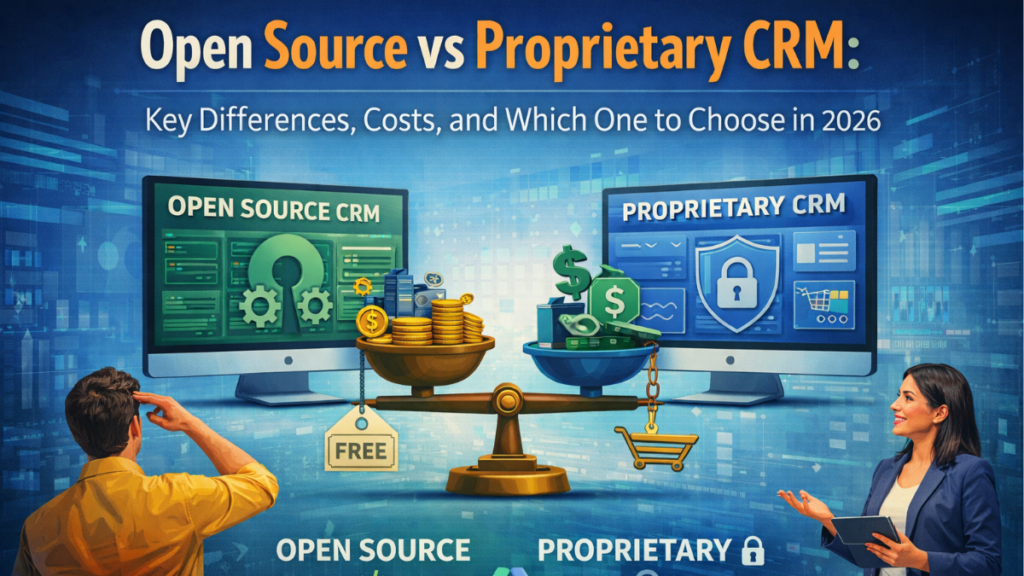
An open source CRM and a proprietary CRM differ mainly in ownership, control, and how the software is managed.
1. What Is an Open Source CRM?
An open source CRM provides access to its source code, allowing you to modify and customize the system:
- Full control over features and functionality
- Can be self-hosted on your own servers
- No mandatory licensing fees (but includes development costs)
This option is ideal if you need deep customization and technical flexibility.
2. What Is a Proprietary CRM?
A proprietary CRM is owned and managed by a company. You access it through a subscription model:
- No access to source code
- Hosted and maintained by the provider
- Includes built-in support and updates
This option focuses on ease of use and faster implementation.
3. Key Differences
- Control: Open source = full control | Proprietary = limited control
- Customization: Open source = unlimited | Proprietary = restricted by platform
- Cost structure: Open source = development + hosting | Proprietary = subscription fees
- Setup: Open source = technical setup required | Proprietary = ready to use
- Support: Open source = community or paid | Proprietary = vendor support included
The decision between open source CRM and proprietary CRM depends on whether you prioritize control and flexibility or simplicity and speed.
Customization and Control: Open Source vs Proprietary CRM Differences
Customization and control are the main factors that separate an open source CRM from a proprietary CRM. Your choice determines how much you can adapt the system to your workflow and how dependent you are on the vendor.
1. Customization in Open Source CRM
An open source CRM gives you full access to the source code, which means:
- Unlimited feature customization
- Ability to build custom modules and functionalities
- Full control over UI/UX and workflows
This allows you to create a CRM that matches your exact business processes, especially for complex or unique models.
2. Control in Open Source CRM
- Full data ownership
- Control over hosting environment
- No dependency on a single vendor
You decide how the system evolves, but you are also responsible for maintenance and security.
3. Customization in Proprietary CRM
A proprietary CRM offers limited but structured customization options:
- Custom fields and pipelines
- Predefined automation workflows
- Configurable dashboards
Customization is restricted to what the platform allows, which can limit advanced use cases.
4. Control in Proprietary CRM
- Data stored on vendor-managed cloud infrastructure
- Platform updates controlled by the provider
- Dependency on vendor roadmap and limitations
This reduces technical effort but limits flexibility and long-term control.
5. Trade-Off: Flexibility vs Simplicity
- Open source CRM → maximum flexibility, higher technical complexity
- Proprietary CRM → ease of use, limited customization
If your business requires deep process customization, open source is stronger. If you need speed and simplicity, a proprietary CRM is more practical.
Pros and Cons of Open Source CRM
An open source CRM offers high flexibility and control, but it also requires more technical resources. Understanding both sides is critical before choosing this model.
Pros of Open Source CRM
- Full customization: Modify features, workflows, and UI to match your exact business processes.
- Complete data ownership: You control your customer data and where it is stored.
- No licensing fees: Most platforms are free to use, reducing initial software costs.
- Vendor independence: No lock-in to a single provider or pricing model.
- Scalable architecture: Can be adapted as your business grows without platform limits.
Cons of Open Source CRM
- Technical complexity: Requires developers for setup, customization, and maintenance.
- Higher implementation time: Slower to deploy compared to ready-to-use solutions.
- Maintenance responsibility: You handle updates, security, and system performance.
- Hidden costs: Hosting, development, and support can increase total cost of ownership.
- Limited official support: Often relies on community forums or paid external services.
An open source CRM is a strong option if you need customization and control, but it requires the right technical capacity to manage it effectively.
Pros and Cons of Proprietary CRM
A proprietary CRM focuses on ease of use, fast implementation, and built-in support. It reduces technical complexity but limits control and deep customization.
Pros of Proprietary CRM
- Easy setup: Ready-to-use platforms with minimal technical requirements.
- Fast implementation: Start managing leads and deals in hours, not weeks.
- Built-in support: Access to vendor customer support and documentation.
- Automatic updates: Security, features, and improvements handled by the provider.
- User-friendly interface: Designed for quick team adoption.
- Integrated ecosystem: Native integrations with marketing, sales, and support tools.
Cons of Proprietary CRM
- Limited customization: Restricted to platform-defined features and configurations.
- Ongoing costs: Monthly or annual subscription fees per user.
- Vendor lock-in: Difficult to migrate data or switch platforms.
- Less control over data: Stored and managed on vendor cloud infrastructure.
- Scaling costs: Expenses increase as you add users or unlock advanced features.
A proprietary CRM is ideal if you prioritize speed, simplicity, and low technical overhead, but it comes with trade-offs in flexibility and long-term cost control.
Ease of Use and Setup: Which CRM Is Easier to Implement?
Ease of use and setup time directly affect how fast your team starts using a CRM and how quickly you see results. The difference between open source CRM and proprietary CRM here is significant.
1. Setup Complexity
- Open source CRM: Requires server setup, configuration, and often developer involvement.
- Proprietary CRM: Cloud-based, ready to use with minimal configuration.
Proprietary solutions offer much faster implementation.
2. Time to First Use
- Open source CRM: Days or weeks depending on customization and infrastructure.
- Proprietary CRM: Hours to a few days for basic setup.
Faster setup leads to quicker ROI and earlier team adoption.
3. Learning Curve
- Open source CRM: Higher learning curve, especially for non-technical teams.
- Proprietary CRM: Designed with user-friendly interfaces and guided onboarding.
Simpler systems improve daily usage and reduce training time.
4. Ongoing Maintenance
- Open source CRM: Requires ongoing maintenance, updates, and troubleshooting.
- Proprietary CRM: Maintenance handled by the provider.
Less maintenance means more focus on sales and operations.
5. Team Adoption Impact
The easier the system, the higher the adoption rate:
- Simple workflows increase consistent usage
- Less friction improves data accuracy
Proprietary CRM is easier to implement and adopt. Open source CRM requires more effort but allows deeper control once fully set up.
Integration Capabilities: Which CRM Works Better with Your Tools?
Integration capabilities determine how well your CRM connects with your existing tools, data sources, and workflows. This directly impacts automation, efficiency, and data consistency.
1. Integrations in Open Source CRM
An open source CRM offers maximum flexibility through API access and custom development:
- Build custom integrations with any tool
- Connect internal systems or proprietary software
- Full control over data flow and synchronization
This is ideal for businesses with complex or unique tech stacks.
2. Integrations in Proprietary CRM
A proprietary CRM provides ready-to-use native integrations:
- Pre-built connections with marketing, sales, and support tools
- Marketplace of third-party apps and extensions
- Simple setup with minimal technical effort
This reduces implementation time and simplifies automation.
3. API and Flexibility
- Open source CRM: Full API control, no restrictions on customization
- Proprietary CRM: API access available but often limited by plan or rate limits
Open source offers deeper integration flexibility, while proprietary prioritizes ease.
4. Speed vs Control
- Open source CRM: Slower to integrate but highly customizable
- Proprietary CRM: Fast integration with standard tools
5. Data Synchronization
Integration quality depends on data sync:
- Real-time vs delayed updates
- Two-way data synchronization
- Consistency across systems
Open source CRM is better for custom integrations and full control. Proprietary CRM is better for fast, plug-and-play connections with common tools.
Scalability and Total Cost: What You’ll Pay Over Time
Scalability and total cost determine whether your CRM remains sustainable as your business grows. The difference between open source CRM and proprietary CRM becomes more visible over time.
1. Initial Cost vs Long-Term Cost
- Open source CRM: Low or no licensing cost, but requires development, hosting, and setup investment.
- Proprietary CRM: Monthly or annual subscription fees with predictable pricing.
Open source appears cheaper upfront, but total cost of ownership depends on technical needs.
2. Cost of Scaling
- Open source CRM: Costs increase with infrastructure, developers, and maintenance.
- Proprietary CRM: Costs increase per user, features, and higher-tier plans.
Growth always increases CRM costs, but the structure is different.
3. Infrastructure and Maintenance
- Open source CRM: You manage servers, updates, and performance.
- Proprietary CRM: Infrastructure handled by the provider.
Maintenance adds hidden operational costs in open source setups.
4. Feature Scaling
- Open source CRM: Add features through custom development.
- Proprietary CRM: Unlock features by upgrading plans.
Open source offers flexibility, while proprietary offers faster access.
5. Predictability of Costs
- Open source CRM: Variable costs depending on development and usage.
- Proprietary CRM: Predictable recurring subscription costs.
6. Long-Term ROI
Evaluate based on outcomes, not just price:
- Impact on conversion rates
- Improvement in team efficiency
- Ability to support business growth
Open source CRM can be more cost-effective with strong technical resources. Proprietary CRM offers predictable costs and faster scalability with less operational overhead.
Data Ownership and Security: Who Controls Your CRM Data?
Data ownership and security define who controls your customer data, how it is stored, and how it is protected. This is a critical difference between open source CRM and proprietary CRM.
1. Data Ownership
- Open source CRM: You have full ownership of your data and complete control over storage.
- Proprietary CRM: Data is stored on the vendor’s cloud infrastructure, with access governed by their policies.
Open source provides maximum control, while proprietary requires trust in the provider.
2. Data Storage and Hosting
- Open source CRM: Can be self-hosted on private servers or custom environments.
- Proprietary CRM: Hosted on managed cloud platforms.
Self-hosting allows full control but adds responsibility for infrastructure management.
3. Security Responsibility
- Open source CRM: You are responsible for security, updates, and protection.
- Proprietary CRM: Security handled by the vendor, including updates and monitoring.
Open source offers control, but requires strong security practices.
4. Compliance and Regulations
- Open source CRM: You manage compliance with data protection laws.
- Proprietary CRM: Many providers include built-in compliance standards (e.g., GDPR).
Compliance is easier with proprietary solutions but less customizable.
5. Data Access and Portability
- Open source CRM: Full access and easy data export.
- Proprietary CRM: Export options may be limited or restricted.
This affects your ability to switch platforms without data loss.
6. Risk vs Convenience
- Open source CRM: Higher control, higher responsibility
- Proprietary CRM: Less control, more convenience
If data control and privacy are critical, open source is stronger. If you prefer managed security and simplicity, proprietary CRM is more practical.
Best Open Source and Proprietary CRM Tools in 2026
Choosing between an open source CRM and a proprietary CRM becomes easier when you understand the leading tools in each category. Each option is built for different levels of control, budget, and technical capacity.
1. Best Open Source CRM Tools in 2026
Open source CRMs focus on flexibility, customization, and data ownership:
- SuiteCRM: Highly flexible and widely used, ideal for complex custom workflows.
- Odoo (Community Edition): Modular system combining CRM with ERP capabilities.
- EspoCRM: Lightweight, customizable, and easier to deploy than most open source options.
- Vtiger (Open Source): Strong for custom workflows and adaptability.
- YetiForce: Advanced features and strong data management, but requires technical expertise.
These tools are ideal if you need full control and the ability to build a CRM tailored to your exact business processes.
2. Best Proprietary CRM Tools in 2026
Proprietary CRMs focus on ease of use, automation, and fast deployment:
- Salesforce: Industry leader with advanced AI, automation, and scalability.
- HubSpot CRM: Best for ease of use and marketing integration.
- Zoho CRM: Strong balance between price and functionality.
- Pipedrive: Excellent for sales pipeline management and usability.
- Microsoft Dynamics 365: Enterprise-level CRM with deep integration and analytics.
- Freshsales: Fast setup, built-in AI, and strong automation for small teams.
These platforms are designed to reduce technical complexity and accelerate team adoption.
3. Key Difference in Tool Selection
- Open source CRM → Best for customization, control, and long-term flexibility
- Proprietary CRM → Best for speed, ease of use, and built-in support
The best choice depends on whether your priority is control and customization or simplicity and fast execution.
Which CRM Is Better for Your Business Type?
The choice between an open source CRM and a proprietary CRM depends on your business type, technical capacity, and how complex your sales processes are.
1. Startups and Small Businesses
- Best fit: Proprietary CRM
Startups usually need fast implementation, low complexity, and minimal technical overhead. Proprietary CRMs provide ready-to-use solutions with built-in automation and support, making them easier to adopt.
2. Growing SMBs (Small to Medium Businesses)
- Best fit: Depends on resources
If you have limited technical resources, a proprietary CRM is more efficient. If you need more custom workflows and have access to developers, an open source CRM becomes a viable option.
3. Enterprises with Complex Processes
- Best fit: Open source CRM (or highly customizable systems)
Large organizations often require deep customization, integration with internal systems, and full data control. Open source CRMs allow complete flexibility to adapt to complex operations.
4. Tech-Driven Companies
- Best fit: Open source CRM
Companies with in-house developers benefit from full control, custom integrations, and the ability to build tailored CRM features.
5. Non-Technical Teams
- Best fit: Proprietary CRM
If your team lacks technical expertise, proprietary CRMs offer easier onboarding, built-in support, and faster adoption.
6. Budget-Constrained Businesses
- Best fit: Open source CRM (with caution)
Open source CRMs eliminate licensing costs, making them attractive for tight budgets. However, hidden costs like hosting and development must be considered.
7. Businesses Focused on Speed and Execution
- Best fit: Proprietary CRM
If your priority is launching quickly and improving sales performance without technical delays, proprietary solutions are more practical.
Summary:
- Open source CRM → Best for technical teams, customization, and control
- Proprietary CRM → Best for speed, ease of use, and fast adoption
The best choice depends on how your business balances control, resources, and execution speed.
When to Choose Open Source vs Proprietary CRM
The decision between an open source CRM and a proprietary CRM depends on your resources, technical capacity, and how much control you need over your system.
1. When to Choose an Open Source CRM
- You need deep customization beyond standard features
- You want full data ownership and control over hosting
- You have access to developers or a technical team
- Your business has complex or unique workflows
- You want to avoid vendor lock-in
Open source is the right choice when flexibility and control are more important than speed.
2. When to Choose a Proprietary CRM
- You need fast implementation with minimal setup
- Your team prefers a user-friendly interface
- You don’t have internal technical resources
- You want built-in support and automatic updates
- Your priority is improving sales execution quickly
Proprietary CRM is the better option when speed, simplicity, and ease of use matter most.
3. Decision Based on Priorities
- Choose open source CRM if your priority is control, customization, and long-term flexibility
- Choose proprietary CRM if your priority is speed, ease of use, and fast adoption
The right decision comes down to whether your business needs technical flexibility or operational simplicity.
Common Mistakes When Choosing Between Open Source and Proprietary CRM
Choosing between an open source CRM and a proprietary CRM without proper evaluation leads to wasted time, higher costs, and poor adoption. These are the most common mistakes to avoid.
1. Choosing Based Only on Price
Many businesses choose open source CRM because it appears free, or proprietary CRM because of simple pricing.
- Open source has hidden costs (hosting, development, maintenance)
- Proprietary CRM costs increase with users and features
How to avoid it: Evaluate the full total cost of ownership, not just the initial price.
2. Ignoring Technical Requirements
Open source CRM requires technical expertise, but many teams underestimate this.
- Lack of developers leads to poor implementation
- System becomes difficult to maintain
How to avoid it: Assess your internal technical capacity before choosing.
3. Overestimating Customization Needs
Some businesses choose open source for customization they never actually use.
- Unnecessary complexity
- Longer setup time
How to avoid it: Choose based on real workflow requirements, not theoretical needs.
4. Underestimating Setup Time
Implementation differences are often ignored:
- Open source = longer deployment time
- Proprietary CRM = faster setup
How to avoid it: Plan realistic timelines for implementation.
5. Ignoring Integration Needs
Choosing a CRM that doesn’t fit your tech stack creates inefficiencies.
- Manual data entry
- Disconnected systems
How to avoid it: Verify integration capabilities before deciding.
6. Not Considering Scalability
A CRM that works today may not work as you grow.
- Open source may require more infrastructure
- Proprietary CRM costs may increase significantly
How to avoid it: Evaluate long-term scalability and growth impact.
7. Ignoring Team Adoption
A CRM only works if your team uses it:
- Complex systems reduce usage
- Poor adoption leads to bad data quality
How to avoid it: Prioritize ease of use and real user experience.
Avoiding these mistakes ensures you choose a CRM solution that fits your business, supports your growth, and delivers real results.
Final Decision Guide: How to Choose the Right CRM for Your Needs
Use this decision framework to choose between an open source CRM and a proprietary CRM based on your real business needs, not assumptions.
Step 1: Define Your Priority
- Control and customization → Open source CRM
- Speed and ease of use → Proprietary CRM
Your main priority should guide the entire decision.
Step 2: Evaluate Your Technical Resources
- Do you have an internal technical team?
- Can you manage development and maintenance?
No technical resources → choose a proprietary CRM.
Step 3: Define Your Budget Structure
- Prefer upfront investment → open source CRM
- Prefer predictable monthly cost → proprietary CRM
Focus on long-term cost sustainability.
Step 4: Analyze Your Sales Process Complexity
- Simple workflows → proprietary CRM
- Complex or custom workflows → open source CRM
Step 5: Check Integration Needs
- Standard tools → proprietary CRM
- Custom systems → open source CRM
Step 6: Consider Time to Implementation
- Need fast deployment → proprietary CRM
- Can invest time in setup → open source CRM
Step 7: Evaluate Long-Term Growth
- Need flexibility over time → open source CRM
- Need predictable scaling → proprietary CRM
Final Decision Rule
- Choose open source CRM if you need control, customization, and flexibility
- Choose proprietary CRM if you need speed, simplicity, and fast adoption
The right CRM decision is the one that aligns with your resources, supports your workflow, and helps your team execute faster and more consistently.
Written by Ana Moedano Rivera