Choosing the right CRM for small businesses in 2026 can directly impact your sales growth, customer relationships, and overall efficiency.
Many small businesses rely on spreadsheets or disconnected tools, leading to missed opportunities, poor follow-ups, and lost revenue. A well-chosen CRM system centralizes your data, automates tasks, and helps you close more deals with less effort.
In this guide, you’ll discover the best CRM tools, key features to look for, real pricing breakdowns, and how to choose the right solution based on your budget and business goals.
What Is a CRM and Why Small Businesses Need One in 2026
A CRM (Customer Relationship Management) system is a tool that helps businesses manage customer data, track interactions, and organize the entire sales process in one place.
1. What a CRM Actually Does
A modern CRM system allows you to:
- Store and manage all customer information
- Track leads and deals through the sales pipeline
- Automate follow-ups and repetitive tasks
- Monitor sales performance and team activity
Instead of scattered data, everything is centralized and actionable.
2. Why Small Businesses Need a CRM in 2026
In 2026, competition is driven by speed, automation, and data. Small businesses that don’t use a CRM often struggle with:
- Missed follow-ups and lost leads
- Poor visibility into the sales pipeline
- Manual processes that waste time
3. Key Benefits for Small Businesses
- Higher conversion rates: Faster and more consistent follow-ups
- Better organization: All customer data in one system
- Increased productivity: Automation reduces manual work
- Improved customer relationships: Personalized communication based on data
4. CRM as a Growth Tool
A CRM is not just a database—it’s a growth engine:
- Helps scale your sales process
- Improves decision-making with data insights
- Supports long-term customer retention
For small businesses, a CRM is no longer optional—it’s a core system that drives sales, efficiency, and sustainable growth.
Key Features to Look for in a CRM for Small Businesses
The best CRM for small businesses is not the one with the most features—it’s the one that improves sales efficiency, simplifies workflows, and drives real revenue growth. Focus on features that your team will actually use daily.
1. Contact and Lead Management
- Centralized customer database
- Complete interaction history (emails, calls, notes)
- Lead tracking across the pipeline
This is the foundation of any CRM—without it, you lose visibility and opportunities.
2. Sales Pipeline Management
- Visual sales pipeline with stages
- Drag-and-drop deal tracking
- Clear view of deal progress
A structured pipeline helps identify bottlenecks and improve conversion rates.
3. Automation and Workflows
- Automated follow-ups and reminders
- Workflow automation for repetitive tasks
- Lead assignment rules
Automation saves time and allows small teams to scale without increasing workload.
4. Reporting and Analytics
- Real-time dashboards
- Sales reports and performance tracking
- Conversion and pipeline analysis
Good analytics turn raw data into actionable insights for better decision-making.
5. Email and Communication Integration
- Email sync (Gmail, Outlook)
- Call logging and communication tracking
- Conversation history per contact
This ensures consistent customer communication and better follow-ups.
6. Integration with Other Tools
- Connection with marketing tools, ads, and support systems
- API access or marketplace integrations
Strong integrations eliminate manual work and unify your tech stack.
7. Ease of Use and Quick Setup
- Simple user interface
- Fast onboarding (hours or days, not weeks)
Small businesses need tools that deliver value quickly—not complex systems that slow teams down.
8. Mobile Access
- Full-featured mobile CRM app
- Real-time updates on deals and contacts
This is essential for sales teams working remotely or in the field.
9. AI and Smart Insights (2026 Standard)
- Lead scoring and prioritization
- Predictive sales insights
- Automated recommendations
Modern CRMs use AI to improve efficiency and decision-making.
10. Scalability
- Ability to add users and features over time
- Flexible pricing plans
Your CRM should grow with your business without requiring a full migration.
Key takeaway: The best CRM features are the ones that improve daily execution—helping you manage leads, automate work, and close deals faster without adding complexity.
How Much Does a CRM Cost? Pricing Breakdown for Small Businesses
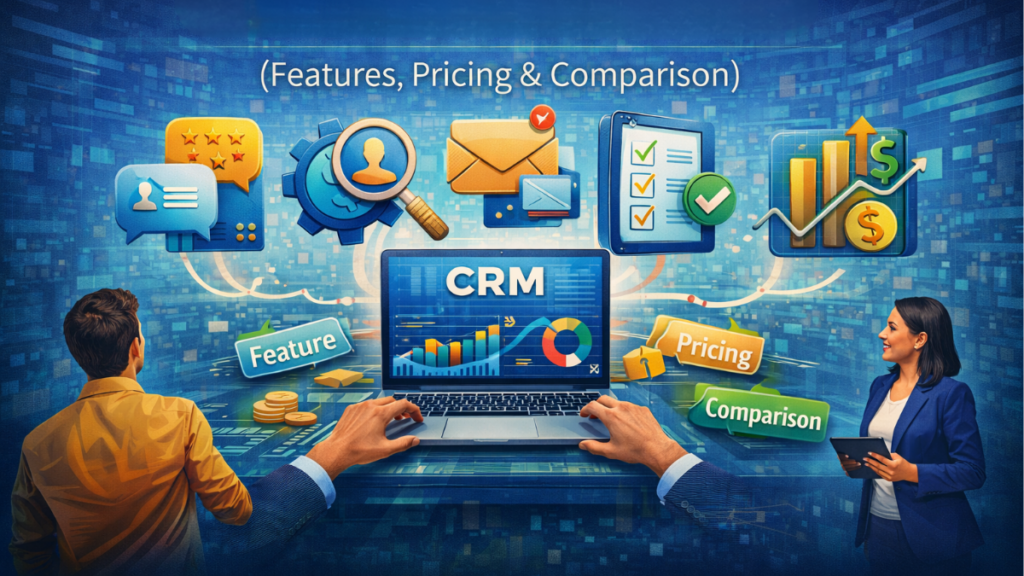
CRM pricing varies widely depending on features, number of users, and business needs. For small businesses in 2026, the key is understanding the real cost—not just the monthly subscription.
1. Average CRM Cost for Small Businesses
- Free CRM: $0/month (limited features)
- Basic plans: $10–$30 per user/month
- Mid-tier plans: $30–$80 per user/month
- Advanced plans: $80–$150+ per user/month
Most small businesses typically spend $10 to $50 per user/month, depending on their needs and growth stage.
2. Pricing Models Explained
- Per-user pricing: Pay for each team member using the CRM
- Tiered plans: Different features unlocked at higher levels
- Flat pricing: Fixed cost for a set number of users (less common)
The more features (automation, analytics, AI), the higher the CRM cost.
3. What You Get at Each Price Level
- Free / Basic: Contact management, simple pipelines
- Mid-tier: Automation, reporting, integrations
- Advanced: AI insights, advanced workflows, customization
4. Hidden Costs You Must Consider
The subscription is not the full picture. Real CRM costs include:
- Implementation and setup
- Data migration
- Paid integrations or add-ons
- Training and onboarding
These can increase total cost by 30–100% beyond the base price.
5. Cost Based on Business Size
- Solo / small teams: Free or $10–$25/user
- Growing teams: $25–$80/user
- Scaling businesses: $80–$150+/user
6. Example Pricing (Real Tools)
- HubSpot CRM: Free plan + paid from ~$15/user/month
- Salesforce: Starts around $25/user/month
- Zoho CRM: From ~$14/user/month
- Pipedrive: From ~$15/user/month
These prices increase as you add automation, AI, and advanced features.
7. ROI vs Cost
A CRM should be evaluated based on return on investment, not just price:
- Improved conversion rates
- Faster sales cycles
- Higher customer retention
Even a $30/month CRM can generate significant revenue growth if used correctly.
Key takeaway: The real question is not “How much does a CRM cost?” but “How much revenue and efficiency does it generate for your business?”
Free vs Paid CRM: Which Option Should You Choose?
Choosing between a free CRM and a paid CRM depends on your business stage, budget, and how advanced your sales process is. Both options can work—but they deliver very different outcomes.
1. What You Get with a Free CRM
- Basic contact management and lead tracking
- Simple sales pipeline
- Limited automation and integrations
- Restrictions on users, storage, or features
Free CRMs are designed as an entry point. They help you organize your customer data without upfront cost, but lack advanced capabilities.
2. What You Get with a Paid CRM
- Full automation for sales and marketing
- Advanced reporting and analytics
- Extensive integrations with other tools
- Customization and scalability
Paid CRMs are built to improve efficiency, enable data-driven decisions, and support long-term growth.
3. When a Free CRM Is the Right Choice
- You have a small team (1–5 users)
- Your sales process is simple
- You’re testing CRM adoption for the first time
- You need basic organization without complexity
Free CRMs are ideal for early-stage businesses that want to get started quickly with minimal risk.
4. When You Should Upgrade to a Paid CRM
- You need automation to scale your operations
- Your team is growing
- You require advanced reporting and insights
- You depend on multiple tools and need integrations
At this stage, a paid CRM often delivers better ROI by saving time and increasing conversion rates.
5. The Hidden Trade-Off
Free CRM saves money upfront, but:
- Limits scalability
- Reduces automation and efficiency
- May require migration later
Paid CRM costs more, but:
- Improves productivity
- Increases sales performance
- Supports long-term growth
6. Best Strategy for Small Businesses
The most effective approach:
- Start with a free CRM to validate your process
- Upgrade to a paid CRM when you need automation and scale
Final takeaway: Choose a free CRM for simplicity and testing, but move to a paid CRM when your focus shifts to growth, efficiency, and maximizing revenue.
The 5 Best CRM Tools for Small Businesses in 2026
These are the top CRM tools for small businesses in 2026 based on ease of use, pricing, features, and real-world business impact. The goal is not just features—but tools that help you close deals and grow efficiently.
Comparison Table
| CRM | Best For | Starting Price | Key Strength | Main Limitation |
|---|---|---|---|---|
| HubSpot CRM | Beginners & marketing-driven teams | Free / ~$20+ | Easy to use + free plan | Gets expensive at scale |
| Zoho CRM | Value + customization | ~$14/user | Strong features at low cost | UI less intuitive |
| Pipedrive | Sales-focused teams | ~$14/user | Visual pipeline | Limited marketing tools |
| Freshsales | Automation + AI insights | Free / ~$9+ | Built-in AI + automation | Less flexible customization |
| Bigin (Zoho) | Very small teams / startups | ~$7/user | Simple and fast setup | Limited advanced features |
1. HubSpot CRM
- Best for: Small businesses starting with CRM
- Key features: Contact management, email tracking, automation, marketing tools
- Why it stands out: Free plan + all-in-one platform
HubSpot is one of the most popular CRMs because it combines sales, marketing, and automation in a single tool, making it ideal for small teams getting started.
2. Zoho CRM
- Best for: Businesses needing customization at low cost
- Key features: Automation, analytics, AI (Zia), multichannel communication
- Why it stands out: Strong value for money
Zoho offers advanced CRM features without enterprise pricing, making it a strong option for growing businesses.
3. Pipedrive
- Best for: Sales teams focused on closing deals
- Key features: Visual pipeline, deal tracking, automation
- Why it stands out: Extremely easy to use
Pipedrive is designed for sales execution, helping teams track deals clearly and improve conversion rates.
4. Freshsales
- Best for: Teams using data and AI for sales
- Key features: AI insights, lead scoring, automation, built-in communication
- Why it stands out: Strong automation + affordability
Freshsales combines AI-driven insights with automation, helping small teams optimize performance without complexity.
5. Bigin (by Zoho)
- Best for: Startups and very small teams
- Key features: Simple pipelines, contact management, quick setup
- Why it stands out: Built specifically for small businesses
Bigin is designed for simplicity and fast adoption, making it ideal if you want a lightweight CRM without complexity.
Key Takeaway
- Best overall: HubSpot CRM (ease + scalability)
- Best value: Zoho CRM
- Best for sales teams: Pipedrive
- Best for automation: Freshsales
- Best for beginners: Bigin
The best CRM for your small business is the one your team will actually use daily—because consistent use is what drives sales growth and ROI.
Best CRM by Business Need: Sales, Marketing, and Support
The best CRM for small businesses depends on your primary goal. Some tools are optimized for sales execution, others for marketing automation, and others for customer support. Choosing based on your main use case improves efficiency and ROI.
1. Best CRM for Sales
- Pipedrive → Best for visual sales pipeline management
- Salesforce → Best for advanced sales automation and forecasting
- Zoho CRM → Strong balance of features and affordability
Sales-focused CRMs prioritize deal tracking, pipeline visibility, and conversion optimization. Tools like Pipedrive and Salesforce are widely recognized for improving sales performance and pipeline control.
2. Best CRM for Marketing
- HubSpot CRM → Best all-in-one marketing + CRM platform
- ActiveCampaign → Strong email marketing automation
- GoHighLevel → Ideal for agencies and funnel-based marketing
Marketing CRMs focus on lead generation, segmentation, and automation. They help capture leads, nurture them, and convert them into customers through data-driven campaigns.
3. Best CRM for Customer Support
- Zendesk CRM → Best for customer service and ticketing
- Freshsales (Freshworks) → Combines sales + support
- HubSpot CRM → Includes integrated customer service tools
Support-focused CRMs prioritize customer experience, including ticket management, communication tracking, and faster issue resolution.
4. All-in-One CRM (Balanced Option)
- HubSpot CRM
- Zoho CRM
- Microsoft Dynamics 365
These platforms combine sales, marketing, and support in a single system, making them ideal for businesses that want a unified customer management platform.
5. How to Choose Based on Your Priority
- Focus on closing deals → Choose a sales CRM
- Focus on lead generation → Choose a marketing CRM
- Focus on customer retention → Choose a support CRM
- Need everything in one → Choose an all-in-one CRM
Key takeaway: The best CRM by business need is the one aligned with your main growth driver—whether that’s sales, marketing, or customer experience.
How to Choose the Right CRM Based on Your Budget and Goals
Choosing the right CRM is not about finding the cheapest tool—it’s about selecting the one that delivers the highest ROI based on your business goals and available budget. A low-cost CRM that your team doesn’t use has zero value, while a slightly higher investment can significantly increase revenue and efficiency.
1. Define Your Primary Goal First
Your CRM choice should start with a clear objective:
- Increase sales → Focus on pipeline and deal tracking
- Generate leads → Prioritize marketing automation
- Improve retention → Focus on customer support features
A CRM aligned with your main goal will deliver faster and more measurable results.
2. Match Features to Your Budget
CRM pricing typically follows feature tiers:
- $0–$30/user → Basic features (contacts, pipeline)
- $30–$80/user → Automation, reporting, integrations
- $80+/user → Advanced analytics, AI, customization
Basic plans are enough for simple workflows, while growing businesses need automation and data insights to scale.
3. Prioritize Value Over Price
Instead of asking “What’s the cheapest CRM?”, ask:
- Will this improve conversion rates?
- Will it save time through automation?
- Will it increase customer retention?
The best CRM is the one that generates more revenue than it costs.
4. Consider Total Cost of Ownership
Your real CRM cost includes more than the subscription:
- Setup and onboarding
- Integrations with other tools
- Training and team adoption
Ignoring these costs can lead to underestimating your actual investment.
5. Choose Based on Your Business Stage
- Early-stage → Free or low-cost CRM
- Growing business → Mid-tier CRM with automation
- Scaling company → Advanced CRM with analytics and AI
Choosing a CRM that fits your current stage prevents overpaying or underinvesting.
6. Plan for Scalability
Don’t choose a CRM only for today:
- Can it handle more users and data?
- Does it offer advanced features as you grow?
Switching CRMs later can be costly due to data migration, training, and lost productivity.
7. Test Before You Commit
- Use free trials or demo versions
- Simulate real sales workflows
- Get feedback from your team
This ensures the CRM fits your daily operations—not just your expectations.
Final Decision Rule
- Limited budget + simple needs → Start with a basic or free CRM
- Growth-focused business → Invest in automation and integrations
- Scaling operations → Choose a CRM with advanced analytics and flexibility
Key takeaway: The right CRM is the one that aligns with your goals, fits your budget, and delivers measurable business results—not just the lowest price.
Common Mistakes When Choosing a CRM
Choosing the wrong CRM can lead to low adoption, poor data quality, and lost revenue opportunities. Avoiding these mistakes helps you select a system that actually improves sales performance and efficiency.
1. Choosing Based on Features Instead of Needs
Many businesses choose the CRM with the most features instead of the one that fits their workflow.
- Complex tools reduce usability
- Unused features increase cost
How to fix it: Focus on features that directly impact your sales process and goals.
2. Ignoring Ease of Use
If your team finds the CRM difficult, they won’t use it:
- Low CRM adoption
- Incomplete or inaccurate customer data
How to fix it: Choose a CRM with a simple user interface and test it with real users.
3. Underestimating Implementation Time
CRM setup is not instant:
- Data migration
- Workflow setup
- Team training
How to fix it: Plan a realistic implementation timeline and allocate resources.
4. Not Considering Integrations
A CRM that doesn’t connect with your existing tools creates inefficiencies:
- Manual data entry
- Disconnected systems
How to fix it: Verify integration capabilities with your tech stack before choosing.
5. Ignoring Total Cost of Ownership
Focusing only on the subscription price leads to surprises:
- Add-ons and premium features
- Integration tools
- Training and setup costs
How to fix it: Calculate the full CRM cost, including scaling and hidden expenses.
6. Choosing a CRM That Doesn’t Scale
A tool that works today may fail as you grow:
- Limits on users or contacts
- Restricted automation
How to fix it: Choose a scalable CRM that supports future growth.
7. Skipping the Testing Phase
Choosing without testing leads to poor fit:
- Unexpected usability issues
- Mismatch with real workflows
How to fix it: Use free trials and simulate real use cases before committing.
8. Not Defining Clear Goals
Without clear objectives, CRM selection becomes random:
- No measurable ROI
- Misaligned features
How to fix it: Define specific goals like increasing conversion rates or improving customer retention.
Key takeaway: The biggest mistake is choosing a CRM without aligning it to your business needs, team capabilities, and growth strategy.
Final Recommendation: How to Choose the Best CRM for Your Business
Choosing the best CRM for your business is not about picking the most popular tool—it’s about selecting the system that your team will actually use to drive sales, improve efficiency, and generate consistent revenue.
1. Start with Your Business Goal
- Increase sales → Choose a CRM with strong pipeline management
- Generate leads → Focus on marketing automation
- Improve retention → Prioritize customer tracking and support tools
A CRM aligned with your main goal will deliver faster ROI.
2. Choose Simplicity Over Complexity
Small businesses benefit more from simple tools:
- Fast onboarding
- Easy daily usage
- Higher team adoption
The real value of a CRM comes from consistent use—not advanced features that go unused.
3. Match the CRM to Your Budget (But Think ROI)
CRM pricing varies widely, but the key is value:
- Free or low-cost tools for simple needs
- Paid plans for automation and scalability
A slightly more expensive CRM can generate higher revenue if it improves conversion rates and saves time.
4. Focus on Features That Drive Results
- Lead and contact management
- Sales pipeline visibility
- Automation for follow-ups
- Reporting for decision-making
These are the features that directly impact growth and efficiency.
5. Plan for Growth from Day One
Your CRM should scale with your business:
- Support more users and data
- Offer advanced features as you grow
Switching CRMs later is costly and disruptive.
6. Test Before You Commit
- Use free trials
- Simulate real workflows
- Get feedback from your team
This ensures the CRM fits your real operations—not just your expectations.
7. Final Decision Framework
- Simple needs + low budget → Start with HubSpot or Bigin
- Growing business → Choose Zoho or Freshsales
- Sales-focused team → Use Pipedrive
Final takeaway: The best CRM is the one that aligns with your business goals, fits your team’s workflow, and helps you execute faster—because execution is what drives results, not features.
Written by Ana Moedano Rivera