Discounts can increase conversion rates—but if used incorrectly, they destroy profit margins. The difference comes down to how well you use your CRM data.
Most businesses apply discounts based on intuition or pressure to close deals, leading to unnecessary revenue loss. A data-driven approach allows you to offer the right discount, to the right customer, at the right time.
In this guide, you’ll learn how to use CRM systems to optimize discounts using data, automation, and customer insights—so you can close more deals without sacrificing profitability.
What Is Discount Optimization in CRM and Why It Matters
Discount optimization in CRM is the process of using customer data, deal history, and sales insights to determine the minimum discount needed to close a deal while protecting profit margins.
1. What Discount Optimization Means
Instead of offering discounts randomly, a CRM system helps you:
- Identify when a discount is actually needed
- Calculate the optimal discount level per deal
- Align pricing decisions with customer value and behavior
The goal is simple: maximize revenue without sacrificing profitability.
2. Why Discount Optimization Matters
- Protects profit margins: Avoid unnecessary discounts that reduce earnings
- Improves deal efficiency: Close deals faster with the right pricing strategy
- Increases conversion rates: Offer discounts only when they impact the outcome
- Standardizes pricing decisions: Reduce inconsistency across sales teams
3. The Problem with Traditional Discounting
Without data-driven pricing, most teams:
- Offer discounts too early in the sales process
- Use fixed discount levels for all customers
- Rely on guesswork instead of CRM data
This leads to lower profit margins and inefficient sales strategies.
4. How CRM Enables Smarter Discounts
A modern CRM system uses:
- Deal history to identify winning discount patterns
- Customer segmentation to personalize offers
- analytics to track pricing performance
Discount optimization turns pricing into a strategic tool—helping you close more deals while maximizing long-term profitability.
How CRM Systems Use Data to Recommend Optimal Pricing
Modern CRM systems use data analysis to recommend the best pricing and discount levels for each deal. Instead of guessing, decisions are based on real customer behavior and historical outcomes.
1. Analyzing Historical Deal Data
CRM platforms track past deals to identify patterns:
- Which discount levels led to closed deals
- Average deal size and pricing ranges
- Win/loss trends based on pricing
This helps define the minimum discount needed to close similar deals.
2. Using Customer Data for Pricing Decisions
Customer profiles provide context for pricing:
- Purchase history and spending behavior
- Industry, company size, or segment
- Customer lifetime value (CLV)
Higher-value customers may justify strategic discounts, while others may not need them.
3. Predictive Analytics and AI
Advanced CRMs use predictive analytics to estimate outcomes:
- Probability of closing a deal at different price points
- Recommended discount range for maximum success
- Suggested next actions for the sales team
This improves pricing accuracy and reduces guesswork.
4. Real-Time Data Signals
CRM systems also use live customer signals:
- Email engagement and response rates
- Website activity or product interest
- Sales interactions and follow-ups
These signals indicate when a discount could influence the decision.
5. Continuous Optimization
Every deal feeds new data into the system:
- Refines pricing models over time
- Improves future discount recommendations
CRM-driven pricing turns discounts into a controlled strategy—helping you close deals at the highest possible profit margin.
Using CRM Data to Predict Deal Win Probability and Optimize Discounts
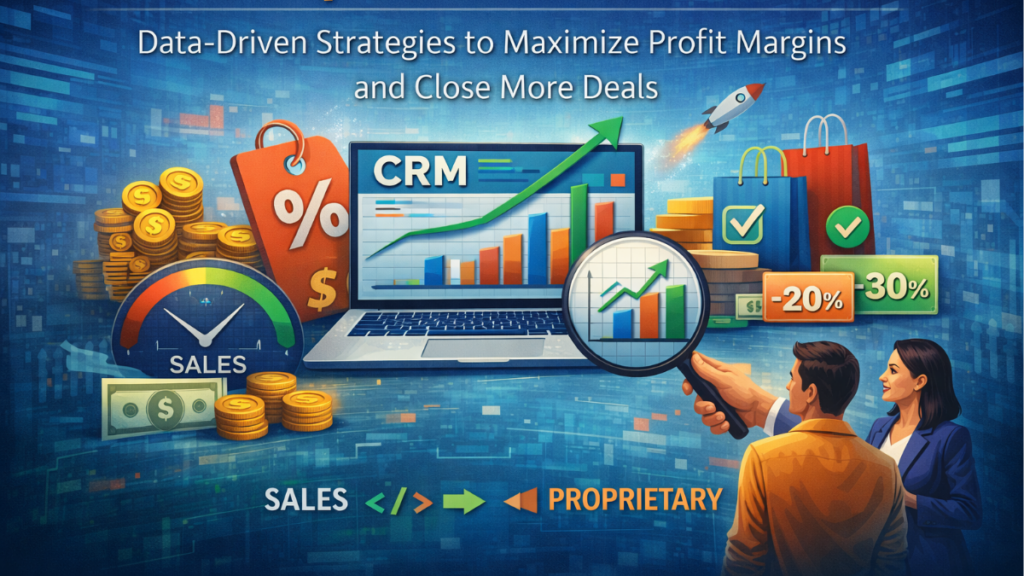
CRM data allows you to estimate the win probability of each deal and adjust discounts based on real likelihood—not guesswork. The goal is to apply discounts only when they increase the chance of closing without reducing profit margins unnecessarily.
1. What Is Deal Win Probability
Win probability is the estimated likelihood that a deal will close based on:
- Deal stage in the sales pipeline
- Historical conversion rates
- Customer engagement and interactions
This helps prioritize where discounts actually make an impact.
2. How CRM Calculates Win Probability
CRM systems use multiple data points:
- Pipeline stage weighting (e.g., proposal vs negotiation)
- Past deals with similar characteristics
- Customer behavior and engagement signals
Advanced systems use predictive analytics to refine these estimates.
3. Applying Discounts Based on Probability
- High probability deals: Avoid or minimize discounts—deal is likely to close anyway
- Medium probability deals: Use targeted discounts to increase close rate
- Low probability deals: Evaluate carefully—discounts may not justify the margin loss
This ensures discounts are used strategically, not automatically.
4. Identifying Discount Impact
CRM data helps measure how discounts affect outcomes:
- Compare win rates with and without discounts
- Track impact on deal size and margins
- Identify optimal discount thresholds
5. Improving Decision-Making Over Time
As more deals are tracked:
- Win probability models become more accurate
- Discount strategies become more data-driven
Using CRM-driven win probability allows you to apply discounts only where they increase conversion—while protecting overall profitability.
Customer Segmentation and Lifetime Value: How to Offer Smarter Discounts
Not all customers should receive the same discount. Using customer segmentation and lifetime value (CLV) inside your CRM allows you to offer discounts strategically—maximizing revenue without hurting profit margins.
1. Segment Customers Based on Value
Start by grouping customers using CRM data:
- High-value customers: Frequent buyers with high revenue potential
- Mid-value customers: Occasional buyers with growth potential
- Low-value customers: Price-sensitive or low engagement
This segmentation helps prioritize where discounts create real business impact.
2. Use Customer Lifetime Value (CLV) to Guide Discounts
Customer lifetime value estimates how much revenue a customer will generate over time:
- High CLV → justify strategic discounts to retain or expand
- Low CLV → limit discounts to protect margins
Discounts should be an investment in future revenue, not just a short-term incentive.
3. Personalize Discounts by Segment
- Loyal customers: Offer exclusive or retention-based discounts
- New leads: Use entry-level discounts to reduce friction
- Inactive customers: Reactivation offers based on past behavior
Personalized discount strategies increase conversion rates and customer satisfaction.
4. Avoid Over-Discounting High-Intent Customers
Not every customer needs a discount:
- High-intent buyers may convert without incentives
- Unnecessary discounts reduce profitability
Use CRM signals (engagement, deal stage) to identify when discounts are actually needed.
5. Combine Segmentation with Behavioral Data
Stronger decisions come from combining:
- Customer segments
- Purchase history
- Engagement behavior
This creates a more accurate view of when and how to apply discounts.
6. Continuously Optimize Segments
Customer segments should evolve over time:
- Update segments based on new data
- Track how each segment responds to discounts
Using CRM segmentation and lifetime value turns discounts into a targeted strategy—helping you increase conversion while protecting long-term profit margins.
How Customer Behavior Signals the Right Time to Offer a Discount
The timing of a discount is often more important than the amount. CRM systems track customer behavior in real time, allowing you to identify when a discount will actually influence a decision—without reducing profit margins unnecessarily.
1. Engagement Signals That Indicate Buying Intent
High engagement often means strong purchase intent:
- Repeated visits to pricing or product pages
- Frequent email opens and clicks
- Active communication with sales
In these cases, avoid early discounts—customers may convert at full price.
2. Drop-Off and Hesitation Signals
When customers slow down or stop engaging, it can indicate friction:
- Unanswered proposals or delayed responses
- Abandoned carts or incomplete sign-ups
- Reduced interaction after initial interest
This is where a targeted discount can help recover the deal.
3. Timing Based on Sales Funnel Stage
- Early stage: Avoid discounts—focus on value and positioning
- Mid stage: Use discounts selectively to overcome objections
- Late stage: Strategic discounts can accelerate closing
Align discounts with the sales funnel to maximize impact.
4. Behavioral Triggers for Automated Discounts
CRM systems can trigger discounts automatically based on behavior:
- No response after a proposal for X days
- Cart abandonment or inactivity
- Repeated product views without conversion
This ensures consistent and timely discount execution.
5. Avoid Discounting High-Intent Buyers Too Early
Offering discounts too soon reduces profitability:
- High-intent users often don’t need incentives
- Early discounts train customers to expect lower prices
6. Combine Behavior with Data Insights
The best decisions come from combining:
- Behavioral signals
- deal history
- customer segmentation
Using CRM behavior tracking allows you to offer discounts at the exact moment they influence conversion—without sacrificing margin.
How to Prevent Profit Margin Loss When Offering Discounts
Discounts can increase sales, but without control, they quickly erode profit margins. The key is to use CRM data and structured rules to ensure every discount is justified and profitable.
1. Set Minimum Margin Thresholds
Define a clear minimum profit margin before applying any discount:
- Establish margin floors per product or service
- Block discounts that fall below acceptable profit levels
This prevents sales teams from closing deals that are not financially viable.
2. Use Data to Define Discount Limits
Analyze past CRM data to determine effective discount ranges:
- Identify the minimum discount needed to close deals
- Avoid over-discounting beyond what impacts conversion
This ensures discounts are optimized, not excessive.
3. Link Discounts to Customer Value
Not all customers justify the same discount:
- High lifetime value (CLV) → strategic discounts may be justified
- Low-value customers → limit discounts to protect margins
Align discounts with long-term revenue potential.
4. Avoid Blanket Discounting
Applying the same discount to all deals reduces profitability:
- Use segmentation to personalize offers
- Adjust discounts based on deal context
5. Implement Approval Workflows
Control discounting with structured approval processes:
- Require manager approval for discounts above a threshold
- Track who applies discounts and why
This reduces uncontrolled discounting behavior.
6. Use Non-Price Incentives
Instead of reducing price, offer additional value:
- Extended support or services
- Bundled features or upgrades
- Flexible payment terms
This maintains pricing integrity while still improving conversion rates.
7. Track Discount Impact on Margins
Monitor how discounts affect performance:
- Margin per deal
- Win rate with vs without discounts
- Revenue vs profitability trends
Preventing profit margin loss is not about avoiding discounts—it’s about using them strategically, based on data, customer value, and clear business rules.
Using Automation, Discount Limits, and Approval Workflows in CRM
To control discounting at scale, you need systems—not manual decisions. A CRM can enforce discount limits, trigger automation, and require approval workflows to protect profit margins while maintaining sales velocity.
1. Set Automated Discount Limits
Define clear discount thresholds directly in your CRM:
- Maximum discount percentage per product or plan
- Different limits based on customer segment or deal size
- Hard stops when discounts exceed margin thresholds
This prevents uncontrolled price reductions at the rep level.
2. Use Rule-Based Automation
Automate when and how discounts are applied:
- Trigger discounts after inactivity (e.g., no response in 5–7 days)
- Apply conditional offers based on deal stage
- Auto-suggest discount ranges using historical data
Automation ensures consistency and faster decision-making.
3. Implement Approval Workflows
Control high-impact discounts with structured approval processes:
- Auto-route deals above a discount threshold to managers
- Require justification fields (reason, competitor pressure, urgency)
- Set multi-level approvals for large deals
This adds accountability and protects profitability.
4. Dynamic Discount Recommendations
Use CRM insights to guide reps:
- Recommended discount range based on similar deals
- Win probability impact at different price points
- Alerts when a discount won’t materially improve conversion
Reps sell with guidance, not guesswork.
5. Guardrails by Role and Region
Customize rules by context:
- Different limits for junior vs senior reps
- Regional pricing rules based on market conditions
- Product-specific constraints for high-margin vs low-margin items
6. Audit Trails and Compliance
Track every discount action:
- Audit logs of who applied discounts and when
- Reason codes for analysis and policy compliance
- Visibility for finance and leadership
7. Continuous Optimization
Refine rules over time:
- Adjust thresholds based on win rate and margin data
- Identify patterns of over- or under-discounting
- Update workflows as sales strategy evolves
Combining automation, discount limits, and approval workflows turns pricing into a controlled system—helping you close deals faster while protecting profit margins.
When to Offer Discounts (and When to Avoid Them)
Knowing when to offer discounts is critical to increasing conversion rates without damaging profit margins. The right timing depends on CRM data, deal context, and customer behavior.
1. When You Should Offer Discounts
- Deal is close to closing but stalled: A small discount can remove final objections
- Clear price resistance: Customer explicitly hesitates due to cost
- Competitive pressure: When a competitor offers a better price
- End of sales cycle or quota period: Strategic discounts can accelerate closing
- High-value customer acquisition: Justified when lifetime value (CLV) is high
In these scenarios, discounts act as a conversion lever, not a default tactic.
2. When You Should Avoid Discounts
- High-intent buyers: Customers already ready to purchase
- Early-stage deals: Discounting too soon reduces perceived value
- No clear objection: Discounting without need lowers profitability
- Low-value customers: Discounts may not justify long-term return
Unnecessary discounts train customers to expect lower prices and reduce margins.
3. Use CRM Signals to Decide
Base decisions on real data instead of assumptions:
- Deal stage and pipeline position
- Customer engagement and responsiveness
- Historical win rates with and without discounts
4. Align Discounts with Business Goals
- Use discounts to increase conversion when needed
- Avoid discounts that reduce profit margins without impact
5. Replace Discounts with Value When Possible
Instead of lowering price, offer:
- Additional features or services
- Flexible payment terms
- Extended support or onboarding
This preserves pricing integrity while improving deal attractiveness.
The goal is not to eliminate discounts—but to use them only when they directly increase the probability of closing while protecting profitability.
Common Mistakes in Discount Strategies (and How to Fix Them)
Most discount strategies fail not because discounts don’t work—but because they are applied without data, control, or clear objectives. These mistakes reduce profit margins and weaken long-term pricing power.
1. Offering Discounts Too Early
Many sales teams introduce discounts at the beginning of the sales process:
- Reduces perceived value
- Eliminates room for negotiation
How to fix it: Delay discounts until there is clear price resistance or late-stage friction.
2. Using One-Size-Fits-All Discounts
Applying the same discount percentage to all customers ignores differences in:
- Customer value
- purchase intent
- Deal size
How to fix it: Use CRM segmentation and lifetime value (CLV) to personalize discounts.
3. Discounting Without Data
Relying on intuition instead of CRM data leads to:
- Over-discounting
- Inconsistent pricing decisions
How to fix it: Analyze historical deal data and track discount impact on conversion and margins.
4. Not Setting Discount Limits
Without clear discount policies, sales reps may:
- Offer unnecessary price reductions
- Prioritize closing over profitability
How to fix it: Implement discount thresholds, approval workflows, and margin controls in your CRM.
5. Ignoring Profit Margins
Focusing only on closing deals without tracking profitability leads to:
- Revenue growth without profit growth
- Unsustainable pricing strategies
How to fix it: Track margin per deal and enforce minimum margin requirements.
6. Training Customers to Expect Discounts
Frequent or predictable discounts create behavior patterns:
- Customers delay purchases waiting for lower prices
- Reduced willingness to pay full price
How to fix it: Use discounts selectively and vary timing and conditions.
7. Not Measuring Discount Performance
Without tracking results, you can’t optimize your strategy:
- No visibility into what works
- No improvement over time
How to fix it: Monitor key metrics like win rate, average discount, and profit margins.
A strong discount strategy is controlled, data-driven, and aligned with business goals—ensuring you increase conversion without sacrificing profitability.
Key Metrics to Track the Success of Your Discount Strategy in CRM
To optimize your discount strategy, you need to measure its real impact on revenue, conversion, and profit margins. A CRM system provides the data needed to track and improve performance over time.
1. Average Discount Rate
- Measures the average discount percentage applied across deals
Use this to identify if your team is over-discounting or maintaining pricing discipline.
2. Win Rate by Discount Level
- Compares conversion rates at different discount levels
This shows the minimum discount needed to close deals and avoids unnecessary margin loss.
3. Profit Margin per Deal
- Tracks actual profitability after discounts
This is one of the most critical metrics—high sales volume means nothing without healthy margins.
4. Revenue vs Discount Impact
- Analyzes how discounts affect total revenue
Helps determine whether discounts are driving growth or just reducing profit.
5. Discount-to-Win Ratio
- Measures how often discounts are used to close deals
If most deals require discounts, your pricing strategy may need adjustment.
6. Customer Lifetime Value (CLV) After Discount
- Evaluates long-term customer value of discounted deals
Ensures discounts lead to profitable, long-term relationships.
7. Sales Cycle Length with vs Without Discounts
- Compares how discounts affect sales cycle duration
Helps determine if discounts are accelerating deals or just reducing price unnecessarily.
8. Discount Approval Rate
- Tracks how often discounts exceed predefined limits
High approval rates may indicate weak discount controls.
9. Deal Size After Discount
- Measures changes in average deal value
Ensures discounts are not significantly reducing overall revenue per deal.
10. Customer Retention After Discount
- Tracks whether discounted customers stay and continue buying
Helps validate if discounts attract valuable long-term customers or just short-term buyers.
Tracking these CRM metrics allows you to continuously refine your discount strategy—maximizing conversion while protecting profit margins.
Best CRM Tools for Pricing Optimization and Discount Management in 2026
Not all CRM tools are built for pricing optimization and discount management. The best platforms combine data analytics, automation, and AI-driven insights to help you maximize profit margins while improving conversion rates.
1. Salesforce (Best for Advanced Pricing and Enterprise Control)
- Strengths: Advanced AI analytics, CPQ (Configure Price Quote), dynamic pricing
- Use case: Complex B2B sales with structured discount approval workflows
Salesforce is ideal for companies that need deep pricing control and predictive discount optimization at scale.
2. HubSpot CRM (Best for Simplicity + Data-Driven Discounts)
- Strengths: Easy automation, deal tracking, strong analytics
- Use case: SMBs optimizing discounts based on pipeline data
HubSpot allows teams to implement data-driven discount strategies without technical complexity.
3. Zoho CRM (Best Value for Pricing Control + Automation)
- Strengths: Custom workflows, AI insights, strong price rules
- Use case: Businesses needing flexible discount automation at lower cost
Zoho offers one of the best balances between cost and pricing optimization features.
4. Microsoft Dynamics 365 (Best for Data-Driven Pricing at Scale)
- Strengths: Advanced analytics, AI forecasting, deep integrations
- Use case: Enterprises managing complex pricing strategies
This platform excels in predictive insights and large-scale discount governance, especially within the Microsoft ecosystem.
5. Pipedrive (Best for Sales-Focused Discount Control)
- Strengths: Visual pipeline, simple deal tracking
- Use case: Teams optimizing discounts based on deal stage
Pipedrive is ideal for teams that want to align discount timing with pipeline movement.
6. Freshsales (Best for AI-Driven Discount Recommendations)
- Strengths: Built-in AI, automation, behavior tracking
- Use case: Businesses using behavioral data to optimize pricing
Freshsales helps identify when discounts actually impact conversion.
7. Pricefx (Best Dedicated Pricing Optimization Platform)
- Strengths: Advanced pricing optimization, margin control, AI-driven pricing
- Use case: Enterprises needing full pricing lifecycle management
Unlike traditional CRMs, Pricefx specializes in maximizing profitability through structured pricing strategies.
8. CPQ and Pricing Software Integrations
Many companies combine CRM with pricing software or CPQ tools:
- Automated quote generation
- Dynamic discount rules
- Real-time margin calculations
These tools integrate with CRM to centralize pricing decisions and improve deal velocity.
Key Takeaway
- Best for enterprise pricing optimization: Salesforce / Dynamics 365 / Pricefx
- Best for SMB discount optimization: HubSpot / Zoho / Freshsales
- Best for sales-driven execution: Pipedrive
The best CRM for pricing optimization is the one that connects data, automation, and discount control—allowing you to increase conversion without sacrificing profit margins.
Real-World Examples of Data-Driven Discount Strategies
Applying data-driven discount strategies in a CRM allows businesses to increase conversion rates while protecting profit margins. These real-world examples show how companies use data, not guesswork, to optimize pricing decisions.
1. SaaS Company Optimizing Discounts by Deal Stage
A SaaS company analyzed its CRM pipeline data and found that:
- Deals in early stages rarely needed discounts
- Deals in late-stage negotiation closed 18% faster with small discounts
Strategy:
- No discounts before the proposal stage
- 5–10% discounts only for late-stage deals with high win probability
Result: Increased conversion rate without reducing overall profit margins.
2. Ecommerce Business Using Behavior-Based Discounts
An ecommerce brand used customer behavior data from its CRM:
- Tracked cart abandonment and browsing activity
- Identified users who hesitated before purchase
Strategy:
- Triggered automated 10% discounts after cart abandonment
- Avoided discounts for high-intent users who returned quickly
Result: Higher conversion with controlled discount usage.
3. B2B Company Using CLV-Based Discounting
A B2B service company segmented customers by lifetime value (CLV):
- High-value clients received tailored discount offers
- Low-value leads received minimal or no discounts
Strategy:
- Invest in discounts only where long-term revenue justified it
Result: Improved customer retention and higher overall ROI.
4. Sales Team Using Win Probability to Control Discounts
A sales team integrated win probability scoring into their CRM:
- High-probability deals received no discounts
- Medium-probability deals received targeted incentives
Strategy:
- Align discounts with deal probability
Result: Reduced unnecessary discounts and increased profit margins.
5. Enterprise Using Approval Workflows to Protect Margins
An enterprise company implemented discount approval workflows:
- Automatic approval for discounts under 10%
- Manager approval required for higher discounts
Strategy:
- Control large discounts while maintaining sales flexibility
Result: More consistent pricing and improved margin control.
Key Takeaways
- Use CRM data to identify when discounts are actually needed
- Align discounts with customer value and deal stage
- Automate and control discounts to avoid margin loss
These examples show that successful discount strategies are not about offering lower prices—they are about using data to maximize both conversion and profitability.
Final Strategy: How to Maximize Profit Without Losing Deals
The goal of any discount strategy is not just to close deals—but to maximize profit margins while maintaining strong conversion rates. This requires a structured, data-driven approach using your CRM.
1. Stop Using Discounts as a Default Tactic
Discounts should be a strategic tool, not a habit:
- Only apply discounts when they increase win probability
- Avoid automatic price reductions in early stages
2. Use Data to Define When and How Much to Discount
- Analyze historical deal data
- Identify the minimum discount level needed to close
- Use CRM insights to guide decisions
3. Align Discounts with Customer Value
- Prioritize high lifetime value (CLV) customers
- Limit discounts for low-value or price-sensitive segments
This ensures discounts generate long-term revenue, not short-term losses.
4. Control Discounts with Systems, Not Decisions
- Set discount limits and margin thresholds
- Use approval workflows for high discounts
- Automate rules inside your CRM
This creates consistency and protects profitability.
5. Focus on Value Instead of Price
Reduce the need for discounts by increasing perceived value:
- Highlight ROI and outcomes
- Offer bundles or added services
- Use differentiation instead of price competition
6. Continuously Measure and Optimize
- Track win rate, average discount, and profit margins
- Adjust strategies based on real performance data
7. Build a Repeatable Discount System
The most effective companies turn discounting into a repeatable process:
- Data-driven decisions
- Clear rules and limits
- Continuous optimization
Final takeaway: The best CRM-driven discount strategy is not about offering more discounts—it’s about offering the right discount, at the right time, to the right customer, while protecting profit margins and maximizing revenue.
Written by Ana Moedano Rivera