CRM security is a business-critical priority in 2026 because customer data is one of the most valuable assets a company holds—and one of the most targeted by attackers. A weak CRM setup can expose sensitive information, damage trust, trigger regulatory penalties, and disrupt sales and marketing operations.
Protecting a CRM system now goes beyond passwords and basic access control. Businesses need stronger safeguards around data storage, user permissions, integrations, compliance, and breach prevention to reduce risk and keep operations secure.
In this guide, you’ll learn the main CRM security risks, the features and tools that matter most, how to stay aligned with data protection regulations, and the practical steps needed to protect customer data without slowing down growth.
What Is CRM Security and Why It Matters in 2026
CRM security is the set of policies, controls, and technologies used to protect the customer data stored inside a CRM system. That includes contact details, purchase history, sales notes, support records, financial information, and any other data used by sales, marketing, and customer service teams.
In practice, CRM security is not just about blocking hackers. It also includes controlling who can access data, reducing internal mistakes, securing integrations, protecting cloud environments, and making sure customer information is handled according to data protection regulations. Core safeguards such as multi-factor authentication, access control, data minimization, and secure data management are widely recommended by security and regulatory guidance.
It matters more in 2026 because CRM platforms now sit at the center of the revenue engine. They connect with email marketing tools, ad platforms, support systems, payment tools, and analytics dashboards. That makes the CRM one of the richest sources of customer intelligence in the business—and one of the most attractive targets for attackers. At the same time, privacy enforcement is getting stricter across regions, and companies are under more pressure to prove that they collect, store, and use customer data responsibly.
A weak CRM setup creates real business risk:
- Data breaches that expose customer records
- Compliance violations that trigger fines or legal issues
- Loss of customer trust that hurts retention and brand value
- Operational disruption across sales, marketing, and support
- Revenue loss caused by downtime, fraud, or damaged reputation
This is why CRM security in 2026 has to be treated as a business function, not just an IT task. A secure CRM protects more than data—it protects your pipeline, your customer relationships, and your ability to scale safely.
From an SEO and business perspective, this topic also matters because buyers are more aware of how their information is used. Companies that can show strong customer data protection, clear compliance practices, and secure operations are in a better position to win trust, close deals, and keep customers longer. GDPR, for example, is technology-neutral and applies regardless of whether personal data is stored in a CRM, another IT system, or even organized manual records.
In simple terms, CRM security is the framework that keeps your most valuable customer data protected, accessible only to the right people, and compliant with the rules that govern how modern businesses handle personal information.
Common CRM Security Risks You Need to Know
A CRM system stores some of the most sensitive business data you have: customer identities, contact records, sales conversations, support history, contract details, and sometimes billing information. That makes it a high-value target for both external attackers and internal misuse.
In 2026, the biggest CRM security risks usually come from weak access controls, phishing, poor configuration, insecure integrations, and human error. Security guidance from CISA and European data protection authorities keeps pointing to the same pattern: most incidents happen because basic controls were weak, not because attackers used exotic techniques.
1. Weak Passwords and Stolen Credentials
One of the most common ways attackers get into a CRM platform is by stealing login credentials through phishing, password reuse, or weak authentication. Once they gain access, they can export customer data, change records, or move deeper into connected systems. CISA specifically highlights phishing as a major path for credential theft, and NIST recommends multi-factor authentication as a core control to reduce this risk.
2. Excessive User Permissions
Many companies give employees broader access than they actually need. That creates unnecessary exposure because a compromised or careless user account can reach more customer data than required. This is especially risky in sales and support teams where many users interact with the CRM daily. Limiting access by role is one of the simplest ways to reduce the blast radius of an incident.
3. Misconfigured CRM and Cloud Settings
A secure platform can still become vulnerable if it is configured badly. Common problems include open APIs, weak session settings, poor logging, disabled MFA, and overly permissive sharing rules. CISA notes that weak security configurations and poor cyber hygiene are routinely exploited, and cloud security guidance from NIST stresses that organizations still retain responsibility for secure configuration even when using cloud services.
4. Insecure Third-Party Integrations
CRMs rarely operate alone. They connect with email platforms, support tools, ad systems, analytics software, payment tools, and automation apps. Every integration adds another possible entry point. If one connected tool has weak security or excessive permissions, it can expose CRM data indirectly. This is why integration security matters as much as the CRM itself.
5. Phishing and Social Engineering
Attackers do not always break in through software flaws. Often, they trick employees into handing over access. A fake login page, a spoofed email, or a fraudulent support request can be enough to compromise a CRM account. CISA’s phishing guidance specifically warns that attackers use these methods to steal credentials and gain access to internal resources.
6. Poor Data Handling by Employees
Not every incident is caused by a malicious actor. Employees can create risk by exporting data unnecessarily, sharing records through insecure channels, using personal devices without safeguards, or storing customer lists outside approved systems. Under GDPR-style frameworks, unauthorized disclosure, loss, or alteration of personal data can still count as a personal data breach, even when the cause is accidental.
7. Lack of Monitoring and Breach Detection
Some businesses focus on prevention but forget detection. If there are no logs, alerts, or access reviews, suspicious activity can go unnoticed for too long. That increases the damage and delays incident response. European data protection guidance also emphasizes that organizations must be able to recognize when a personal data breach has occurred so they can assess and respond appropriately.
8. Ransomware and Data Exfiltration
CRM data is valuable not only for direct theft but also for extortion. Attackers may encrypt systems, steal records, or both. CISA warns that ransomware-caused breaches can lead to financial losses and serious erosion of customer trust, which is especially damaging when the affected system contains sensitive customer information.
Key Takeaway
The biggest CRM security risks are usually predictable: stolen credentials, overexposed access, insecure integrations, weak configurations, and human mistakes. The practical lesson is simple: protect the CRM like a revenue-critical system, because that’s exactly what it is. The businesses that do this well reduce breach risk, protect customer data, and stay in a much stronger position to meet compliance requirements.
Key Security Features Every CRM Should Have
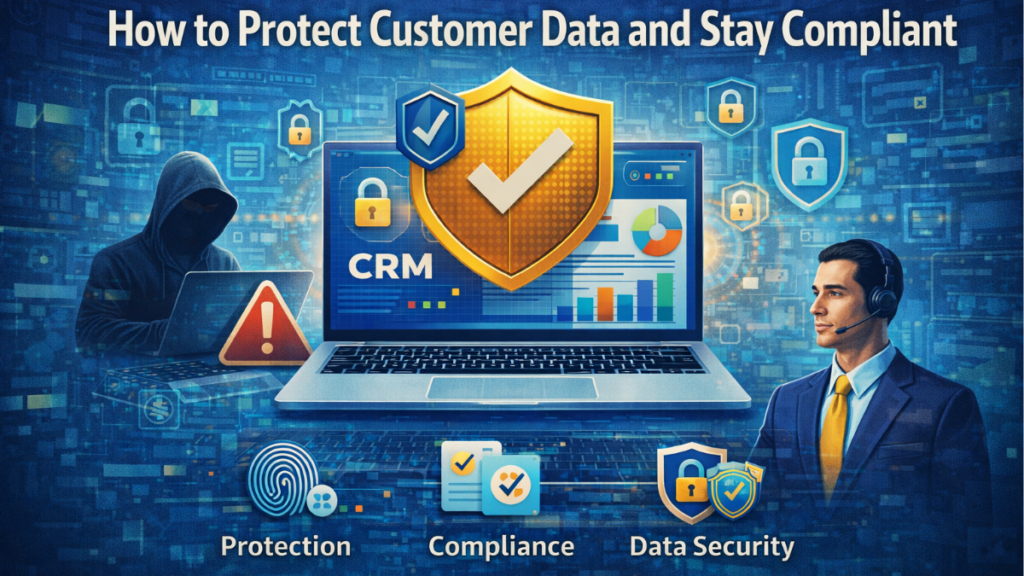
A secure CRM system should do more than store customer records. It should actively reduce the risk of unauthorized access, data loss, account compromise, and compliance failures. In 2026, the minimum standard is no longer basic login protection. A modern CRM needs layered controls that protect customer data across access, storage, integrations, and incident response. Core security baselines from CISA and NIST emphasize controls such as multi-factor authentication, least-privilege access, logging, secure configuration, backups, and recovery planning.
1. Multi-Factor Authentication (MFA)
Multi-factor authentication is one of the most important features any CRM should offer. Passwords alone are not enough, especially when phishing and credential theft remain common attack paths. MFA adds a second layer of verification, which makes stolen passwords much less useful to attackers. NIST and CISA both recommend MFA as a foundational security control.
2. Role-Based Access Control
A CRM should let you limit access based on job role, department, or responsibility. This follows the least privilege principle: users should only see the data and features they actually need. That reduces the damage caused by compromised accounts, insider misuse, or simple mistakes. This is especially important in companies where sales, support, marketing, and finance all use the same platform.
3. Encryption in Transit and at Rest
Your CRM should protect data both while it is moving and while it is stored. That means using secure transport encryption for logins, APIs, and synced data, plus encryption for stored customer records and backups when appropriate. Encryption helps reduce exposure if traffic is intercepted or if stored data is accessed improperly. ENISA guidance specifically highlights encryption as an important security measure, including for archived data and incident impact reduction.
4. Audit Logs and Activity Monitoring
A secure CRM should record who logged in, what was viewed, what was changed, what was exported, and when those actions happened. Audit logs are critical for detecting suspicious activity, investigating incidents, and proving accountability. CISA’s guidance stresses visibility, protected logs, and monitoring as key parts of effective cyber defense. :
5. Granular Permission Settings
Beyond general role control, strong CRMs should support granular permissions for records, fields, exports, integrations, and admin actions. For example, a sales rep may need access to lead records but not bulk export rights, billing fields, or security settings. This reduces unnecessary exposure and helps support compliance by limiting access to sensitive personal data.
6. Secure API and Integration Controls
Because most CRMs connect to marketing automation, support platforms, analytics tools, and other apps, integration controls matter a lot. A secure CRM should allow you to manage API keys safely, restrict scopes, review connected apps, and disable unnecessary integrations. This helps reduce the risk that a weak third-party tool becomes a back door into your customer data. Supply chain and third-party risk management are now a standard part of modern cybersecurity guidance.
7. Backup and Recovery Capabilities
A CRM should make it easy to recover from accidental deletion, ransomware, misconfiguration, or service disruption. That means secure backups, tested recovery procedures, and clear business continuity options. Backups matter not just for disasters but also for fast restoration when data is corrupted or changed incorrectly. CISA and ENISA both emphasize backups and recovery planning as practical protections against major incidents.
8. Alerts and Suspicious Activity Detection
Strong platforms should support alerts for unusual logins, failed access attempts, mass exports, privilege changes, or sudden integration activity. This shortens detection time and gives teams a chance to respond before a small issue turns into a full data breach. Security visibility and incident detection are repeatedly highlighted by CISA as essential controls.
9. Data Retention and Deletion Controls
Not all customer data should live in the CRM forever. A secure platform should support retention rules, deletion workflows, and administrative controls that help businesses remove data when it is no longer needed. This matters for both risk reduction and compliance, because retaining unnecessary personal data increases exposure. ENISA’s data protection materials and EU data protection frameworks support minimizing unnecessary personal-data risk.
10. Incident Response Support
No system is risk-free, so a good CRM should support incident response through logs, access history, admin controls, recovery tools, and export visibility. These features make it easier to investigate what happened, contain damage, and meet breach-notification obligations when required. Incident handling and response planning are core parts of current security guidance.
Key Takeaway
The best CRM security features are the ones that reduce real-world risk: MFA, least-privilege access, encryption, audit logs, integration controls, backups, monitoring, and recovery support. If a CRM lacks these basics, it is not just missing features—it is increasing your exposure to breaches, downtime, and compliance problems. In 2026, a secure CRM should help you protect customer data without slowing down sales, marketing, or growth.
CRM Compliance: GDPR and Other Data Protection Regulations
CRM compliance means making sure your CRM system collects, stores, uses, shares, and deletes customer data in a way that aligns with applicable data protection regulations. In 2026, this is not optional. If your CRM handles personal data, compliance affects how you run sales, marketing, customer support, and analytics.
The main point is simple: a CRM is not just a sales tool. It is a database of personal data, and that means privacy laws apply to how that data is managed. The European Commission explains that the GDPR applies whenever personal data is processed, regardless of the technology used.
1. GDPR: The Main Global Reference Point
GDPR remains the most influential privacy framework for businesses that serve EU residents or process their personal data. It requires companies to have a lawful basis for processing data, inform users clearly, protect that data with appropriate security measures, and respect rights such as access, correction, deletion, restriction, and portability. The European Commission and the European Data Protection Board both outline these obligations clearly.
For a CRM platform, that affects things like:
- What customer data you collect
- Why you collect it
- How long you keep it
- Who can access it
- Whether it is shared with third-party tools
- How users can request access or deletion
If your CRM stores more data than necessary, keeps it too long, or uses it for purposes the user did not reasonably expect, your compliance risk goes up fast.
2. Data Minimization and Purpose Limitation
Two of the most important GDPR principles for CRM management are data minimization and purpose limitation. That means you should only collect the customer data you actually need, and you should only use it for the specific purposes you communicated. The UK ICO and EU guidance both emphasize that organizations should avoid collecting excessive information and should not reuse data in incompatible ways.
In practice, this means a business should not use its CRM as a dumping ground for every possible field, note, export, or contact list. The more unnecessary personal data you keep, the larger your risk surface in the event of a breach or audit.
3. Consent, Lawful Basis, and Marketing Use
Many businesses get this wrong inside their CRM. Not all data processing depends on consent, but every activity must have a valid lawful basis. For example, some customer communication may rely on contract performance or legitimate interests, while some forms of direct marketing may require consent depending on the jurisdiction and channel. The GDPR framework requires organizations to document and justify that basis.
This matters in CRM workflows because your team may use customer records for:
- Email marketing
- Lead nurturing
- Sales outreach
- Retargeting audiences
- Customer support follow-up
If consent is required for a specific activity, your CRM should be able to record it, timestamp it, and update preferences when a user opts out. Without that, compliance becomes hard to prove.
4. Data Subject Rights Must Be Operational, Not Theoretical
Privacy laws do not just require policies. They require execution. Under GDPR, individuals can request access to their data, ask for corrections, object to certain processing, and in many cases request deletion. That means your CRM compliance workflow needs to make those requests manageable in practice, not just on paper. The European Commission and EDPB both note that organizations must be able to respond to these rights properly.
A compliant CRM setup should make it possible to:
- Find all records linked to a person
- Export that data when needed
- Correct inaccurate information
- Delete or suppress records where legally required
- Track when requests were received and completed
5. Other Data Protection Regulations You Need to Watch
GDPR is not the only law that matters. In 2026, many businesses also need to consider laws such as the CCPA/CPRA in California, Brazil’s LGPD, and other regional privacy regulations. These laws differ in details, but they generally push companies toward the same direction: transparency, access control, consumer rights, responsible sharing, and stronger governance around personal data. California’s privacy regulator and Brazil’s data protection authority both describe rights and obligations that affect how customer data is handled in business systems.
The practical takeaway is that if your business serves multiple regions, your CRM should be configured for the strictest relevant standard instead of trying to manage privacy in fragments.
6. Third-Party Processors and Cross-Border Data Transfers
Your CRM rarely works alone. It usually connects with email platforms, analytics tools, automation systems, support software, and ad networks. From a compliance perspective, that means your CRM vendor and connected tools may act as data processors or sub-processors. GDPR requires businesses to use processors that provide sufficient guarantees around security and lawful data handling. The EDPB and European Commission both address processor responsibilities and international data-transfer rules.
This is especially important when data is stored or accessed outside the jurisdiction where it was collected. Businesses need to understand:
- Where CRM data is hosted
- Which vendors can access it
- What contracts govern that processing
- Whether international transfers have the required safeguards
7. Security Is Part of Compliance
CRM compliance is not just about consent banners and privacy policies. Security controls are part of the legal requirement. GDPR specifically requires “appropriate technical and organisational measures” to protect personal data. That includes things like access control, encryption where appropriate, breach detection, and secure processing practices.
This is why weak permissions, shared logins, insecure integrations, and poor retention practices are not just security problems. They can also become compliance failures.
Key Takeaway
CRM compliance in 2026 means treating your CRM as a regulated environment for customer data, not just a sales database. The strongest approach is to combine GDPR principles, regional privacy-law awareness, clear consent and lawful-basis tracking, strong data governance, and practical user-rights workflows. Businesses that do this well reduce legal risk, strengthen trust, and make their CRM safer and more scalable at the same time.
Cloud vs Private CRM: Where Should Your Customer Data Be Stored?
Choosing between a cloud CRM and a private CRM is really a decision about control, risk, compliance, and operational capacity. Both models can protect customer data, but they do it in different ways, and the right choice depends on your business requirements rather than a universal “best” option.
From a compliance perspective, the first thing to understand is that privacy obligations do not disappear based on where the data is hosted. The GDPR applies to personal data processing regardless of the technology used or how the data is stored.
1. What a Cloud CRM Means
A cloud CRM stores customer data on infrastructure managed by a third-party provider. You access the system over the internet, and the vendor typically handles hosting, uptime, updates, and much of the platform-level security.
The main advantage is speed and scalability. Cloud CRM platforms are usually easier to deploy, easier to update, and often more cost-effective for small and mid-sized businesses. Security can also be strong, because large cloud providers often have mature infrastructure, monitoring, and defense capabilities that many smaller businesses cannot match internally. ENISA notes that cloud-based defenses can be more robust, scalable, and cost-effective, even though cloud environments also concentrate risk.
2. What a Private CRM Means
A private CRM usually refers to a self-hosted or privately managed deployment where your organization has more direct control over infrastructure, configuration, data location, and access. This can be on your own servers or in a dedicated private environment.
The biggest advantage is control. A private setup can make sense when your business has strict data-governance requirements, industry-specific security obligations, unusual customization needs, or internal policies that require tighter control over where data is stored and who manages the environment.
But more control also means more responsibility. Security, maintenance, patching, backups, monitoring, and recovery become your problem or your managed provider’s problem. NIST guidance on cloud and security makes this point clearly in broader form: even when using external services, organizations still retain responsibility for their own security controls and risk management decisions.
3. Cloud CRM: Main Advantages
- Faster deployment with less infrastructure overhead
- Automatic updates and vendor-managed maintenance
- Easier scaling as teams and data volume grow
- Often lower upfront cost compared with private deployments
- Strong built-in ecosystems for integrations, automation, and analytics
For many companies, especially SMBs and growth-stage SaaS businesses, a cloud CRM platform is the more practical option because it reduces operational friction while still offering strong security features.
4. Private CRM: Main Advantages
- Greater control over data storage and infrastructure choices
- More flexibility for custom security policies and niche workflows
- Easier alignment with strict internal governance requirements
- Potentially more control over geographic data residency
This model is often more attractive for organizations in regulated environments or for businesses with internal security teams capable of managing a more complex setup.
5. The Real Trade-Off: Convenience vs Operational Burden
The most common mistake is assuming that private CRM automatically means “more secure” and cloud CRM automatically means “less secure.” That is not how risk works in practice.
A poorly managed private deployment can be far less secure than a well-configured cloud CRM. On the other hand, a cloud CRM with weak access controls, risky integrations, and bad user-permission policies can also expose customer records. CISA’s cloud guidance emphasizes secure configuration and strong access practices because cloud adoption by itself does not guarantee security.
The real question is this: which model can your business secure and govern more effectively over time?
6. Compliance and Data Residency Considerations
If your business operates across regions, where data is stored and accessed matters. The EU notes that personal data transferred to third countries requires appropriate safeguards such as adequacy decisions, standard contractual clauses, or binding corporate rules.
That means when evaluating a CRM storage model, you should look at:
- Where customer data is physically hosted
- Which countries support teams or vendors can access it from
- Whether the provider offers data-region choices
- What contractual protections exist for cross-border transfers
For some businesses, those requirements are manageable in a cloud CRM. For others, they push the decision toward a private or region-specific deployment.
7. Which Option Is Better for Most Businesses in 2026?
For most small and mid-sized companies, a reputable cloud CRM is usually the better choice because it offers faster implementation, strong built-in security options, better integration support, and lower operational complexity. That can lead to a more secure real-world outcome simply because the system is easier to maintain properly.
A private CRM is usually the better fit when you have one or more of these conditions:
- Strict regulatory or contractual data-location requirements
- Very specific customization or isolation needs
- An internal team capable of handling security operations well
- A risk model that demands deeper infrastructure control
Key Takeaway
The best place to store customer data is the environment your business can secure, monitor, govern, and keep compliant over time. For many companies, that will be a strong cloud CRM. For others, a private CRM makes more sense because of control and compliance needs. The smart decision is not about chasing theory—it is about matching the storage model to your security maturity, legal obligations, and growth strategy.
Third-Party Integrations and CRM Security Risks
Third-party integrations make a CRM system far more useful, but they also expand the attack surface around your customer data. Every connection to an email platform, support tool, payment app, analytics suite, automation platform, or ad network creates another path through which data can be accessed, transferred, modified, or exposed.
That is the core risk: your CRM may be secure on its own, but the moment it connects to outside tools, your security posture also depends on those tools, their permissions, their vendors, and how the integrations are configured. CISA and NIST both treat third-party and supply-chain risk as a core part of modern cybersecurity, not a side issue.
1. Over-Permissioned Integrations
One of the most common problems is giving an integration more access than it actually needs. A tool that only needs to read contact fields may end up with permission to export records, modify data, or access sensitive notes. If that connected app is compromised, the exposure becomes much larger than necessary. CISA’s ransomware guidance specifically recommends least privilege and limiting third-party access.
How to reduce the risk:
- Grant only the minimum scopes and permissions required
- Review app permissions before installation and during audits
- Disable integrations that no longer serve a clear business purpose
2. Weak Vendor Security
Your CRM can inherit risk from vendors that do not have strong security controls. A third-party app with weak authentication, poor logging, insecure APIs, or slow patching can become the easiest route into your data ecosystem. This is why vendor risk should be treated as part of CRM security, not just procurement. CISA’s performance goals and federal risk-assessment frameworks both emphasize supplier and third-party risk management.
How to reduce the risk:
- Vet vendors before connecting them to your CRM
- Check whether they support MFA, logging, encryption, and role-based access
- Prefer providers with transparent security documentation and incident processes
3. Insecure API Connections
Many CRM integrations rely on APIs, and poorly protected API keys or tokens can become a direct access path to customer records. If keys are stored badly, shared carelessly, or never rotated, attackers may not need to compromise user accounts at all. That turns integration security into a high-priority operational issue.
How to reduce the risk:
- Store API credentials securely
- Rotate keys and tokens on a defined schedule
- Restrict API scopes and monitor unusual usage
4. Hidden Data Sharing and Data Sprawl
Some integrations copy CRM data into external systems automatically. Over time, this creates data sprawl: customer information ends up spread across multiple platforms, exports, automations, and dashboards. That makes access control harder, increases breach impact, and complicates deletion or correction requests under privacy laws.
From a compliance angle, this matters because if personal data flows to processors or sub-processors, those relationships still need to be governed properly. The EDPB has stressed that controllers must be able to demonstrate compliance across the processing chain, even when sub-processors are involved.
How to reduce the risk:
- Map where CRM data goes after each integration is enabled
- Avoid syncing unnecessary fields to outside tools
- Document processors, sub-processors, and data flows
5. Cross-Border Data Transfer Issues
Some integrations process or store data outside the region where it was collected. That can create extra compliance obligations, especially for businesses handling EU personal data. The EDPB states that GDPR restricts transfers of personal data outside the EEA unless the required conditions and safeguards are met.
How to reduce the risk:
- Check where integrated vendors host and access data
- Verify transfer mechanisms and contractual safeguards
- Prefer region-aware vendors when residency matters
6. Poor Offboarding and Forgotten Connections
Old integrations often stay connected long after teams stop using them. These forgotten connections may still hold tokens, permissions, and background sync access. That creates silent exposure, especially when no one is actively monitoring the app anymore.
How to reduce the risk:
- Run scheduled integration reviews
- Remove unused apps and revoke old credentials
- Include third-party access in employee and vendor offboarding workflows
7. Limited Visibility Into Third-Party Activity
Many teams know which apps are connected to the CRM, but not what those apps are doing in practice. Without logs, alerts, or access reviews, a risky integration can operate unnoticed for too long. CISA’s baseline goals emphasize logging, monitoring, and visibility as core risk-reduction measures.
How to reduce the risk:
- Track login activity, exports, sync actions, and permission changes
- Enable alerts for unusual API or bulk-access behavior
- Review integration activity during security audits
Key Takeaway
Third-party CRM integrations create value, but they also create dependency risk. The safest approach is to treat every connected app as a potential extension of your CRM itself. That means applying least privilege, vetting vendors, controlling data flows, monitoring activity, and documenting compliance obligations across the chain. Businesses that do this well keep the benefits of automation and connectivity without turning their CRM into an easy entry point for breaches or regulatory problems.
How to Prevent Data Breaches in Your CRM
Preventing a CRM data breach is not about relying on one feature. It requires a layered approach that protects customer data across logins, permissions, integrations, devices, backups, and daily workflows. In most cases, breaches happen because basic controls were weak, misconfigured, or ignored—not because the attacker used a highly advanced method. CISA explicitly warns that weak security controls and poor practices are routinely exploited, and recommends stronger access control, credential hardening, and centralized logging.
1. Enforce Multi-Factor Authentication Everywhere
Multi-factor authentication is one of the most effective ways to reduce unauthorized access to a CRM system. Passwords alone are too easy to steal through phishing, reuse, or weak credential habits. NIST states that passwords alone are not effective for protecting sensitive business assets, and CISA recommends MFA broadly as a core security measure.
How to apply it:
- Require MFA for all CRM users, especially admins
- Use phishing-resistant MFA when possible
- Extend MFA to connected apps and admin consoles
2. Limit Access with Least-Privilege Permissions
Not every employee should have full access to all records, exports, settings, or integrations. The least-privilege model reduces the damage a compromised or careless account can cause. CISA recommends controlling access and disabling accounts that are no longer needed, while EU guidance emphasizes access-control policies and regular access reviews as breach-prevention measures.
How to apply it:
- Assign access by role, team, and responsibility
- Restrict export permissions and admin rights
- Review permissions regularly and remove unused accounts
3. Keep Your CRM, Integrations, and Devices Updated
Outdated software creates easy opportunities for attackers. CRM security depends not just on the main platform, but also on browsers, plugins, mobile devices, middleware, and third-party integrations. The EDPB highlights keeping systems up to date as part of breach prevention, and CISA repeatedly warns that weak cyber hygiene is a common cause of compromise.
How to apply it:
- Enable automatic updates where possible
- Patch connected tools and browser extensions quickly
- Retire unsupported apps and stale integrations
4. Monitor Activity and Centralize Logs
You cannot stop what you cannot see. A strong CRM security setup should track logins, exports, permission changes, API activity, and suspicious access patterns. CISA specifically recommends establishing centralized log management and monitoring for anomalies that may indicate malicious activity.
How to apply it:
- Enable audit logs for user and admin activity
- Set alerts for unusual exports, failed logins, or privilege changes
- Review logs regularly instead of collecting them passively
5. Secure Third-Party Integrations and API Access
Many CRM breaches happen through the surrounding ecosystem rather than the CRM itself. Integrations, API keys, and connected apps can create high-risk entry points if they have broad permissions or weak security. Controllers are also expected to use processors that provide sufficient guarantees for secure processing under GDPR-related guidance.
How to apply it:
- Grant integrations only the permissions they need
- Rotate API keys and revoke unused tokens
- Review vendor security before connecting new tools
6. Train Employees to Recognize Risk
Human error remains one of the biggest causes of customer data exposure. Phishing, unsafe exports, weak password habits, and careless sharing can all lead to incidents. CISA’s phishing guidance and EDPB breach guidance both support practical staff training as part of prevention.
How to apply it:
- Train teams to spot phishing and fake login pages
- Set rules for exporting, sharing, and storing CRM data
- Repeat training regularly instead of treating it as a one-time task
7. Back Up CRM Data and Test Recovery
Backups do not prevent the initial incident, but they greatly reduce damage from ransomware, accidental deletion, or destructive account misuse. NIST recommends regularly backing up data and testing those backups, and CISA includes backups as a core ransomware defense.
How to apply it:
- Maintain secure, tested backups of critical CRM data
- Protect backup access with strong authentication
- Document how records will be restored after an incident
8. Minimize the Amount of Data You Keep
The more personal data stored in your CRM, the more valuable the target becomes and the greater the impact of a breach. Reducing unnecessary stored data lowers both security and compliance risk. Privacy guidance consistently supports minimizing retained personal data and limiting access to what is necessary.
How to apply it:
- Remove unused fields, stale records, and duplicate data
- Set retention rules for old contacts and exports
- Avoid syncing sensitive data unless it has a clear business need
9. Prepare an Incident Response Process Before You Need It
No system is risk-free, so prevention should include preparation. If suspicious activity or a breach happens, your team should know how to contain it, investigate it, and assess whether notification is required. The EDPB states that controllers should act immediately upon becoming aware of a breach to contain the incident, assess risk, and determine notification duties.
How to apply it:
- Define who handles CRM security incidents
- Document escalation and containment steps
- Keep breach-notification obligations in mind for regulated data
Key Takeaway
The most effective way to prevent data breaches in your CRM is to combine MFA, least-privilege access, regular updates, integration control, employee training, centralized logging, secure backups, and a clear incident response process. Businesses that treat their CRM like a revenue-critical system—not just a contact database—are much better positioned to protect customer data, reduce breach risk, and stay compliant.
The Role of Employees in CRM Security and How to Reduce Human Error
Employees are one of the biggest strengths in CRM security—and also one of the biggest risks. A secure CRM system can still be exposed if users click phishing links, reuse weak passwords, export customer records carelessly, or access data they do not actually need. Security agencies and data protection regulators consistently point to the same reality: human error is a major cause of incidents involving customer data. CISA recommends ongoing user awareness training and suspicious-activity reporting, while the EDPB specifically highlights safeguards to prevent personal data breaches caused by human mistakes.
1. Employees Are the Daily Operators of CRM Risk
Most CRM exposure does not happen because staff are malicious. It happens because they are busy, distracted, undertrained, or working with weak processes. A sales rep may download a contact list to the wrong device. A marketer may connect an app with excessive permissions. A support agent may fall for a fake login page. These are workflow failures as much as security failures.
This matters because employees interact with the CRM every day. They create records, edit notes, upload files, export data, and connect tools. If those actions are not governed well, small mistakes can turn into data breaches, compliance problems, or major trust damage. The EDPB’s SME guidance explicitly says users handling personal data should be made aware of privacy risks, the measures in place, and the consequences of failure.
2. The Most Common Employee-Driven CRM Security Risks
- Phishing and fake login pages that steal CRM credentials
- Password reuse across multiple business tools
- Sharing or exporting customer data through insecure channels
- Accidentally granting too much access to coworkers or third-party apps
- Using personal or unmanaged devices without proper safeguards
- Leaving stale accounts active after role changes or offboarding
CISA’s ransomware guidance specifically calls for awareness training on social engineering and suspicious activity because employees with network and application access are frequent targets. NIST also recommends awareness training on recognizing and reporting insider-threat indicators and applying least privilege.
3. Training Should Be Practical, Not Generic
One of the biggest mistakes companies make is treating security training like a checkbox. Generic annual slides do very little to reduce CRM mistakes. What works better is short, role-based training tied to real tasks employees actually perform.
For example:
- Sales teams should learn safe handling of exports, lead lists, and mobile CRM access
- Marketing teams should learn secure app connections, audience syncing, and consent handling
- Support teams should learn identity verification and safe case-note practices
- Admins should learn permission design, logging, and secure configuration
NIST has long supported role-based security training, and CISA’s small-business guidance frames cybersecurity tasks by role because risk is easier to reduce when responsibilities are concrete.
4. Reduce Human Error with Better System Design
You cannot solve every problem with training alone. The CRM itself should be configured to make unsafe actions harder and safe actions easier.
Best ways to do that:
- Require multi-factor authentication for all users
- Use role-based access control so employees only see what they need
- Restrict bulk exports and sensitive admin functions
- Set automatic session timeouts and login alerts
- Use approval workflows for high-risk changes or integrations
This is the practical side of reducing human error: design the system so one mistake does not expose the whole database. NIST and CISA both emphasize least privilege, access control, and layered safeguards rather than relying on user behavior alone.
5. Build a Reporting Culture, Not a Blame Culture
Employees are more likely to hide mistakes if they think reporting them will only lead to punishment. That makes incidents worse. A better approach is to create a culture where suspicious emails, accidental shares, unusual logins, and process failures are reported quickly.
CISA recommends training users to identify and report suspicious activity, and that matters because fast reporting can stop a credential theft or improper data disclosure before it becomes a major incident.
Good internal practices include:
- A clear channel for reporting suspicious activity
- Fast escalation for possible CRM security incidents
- Simple internal rules on what to report and when
- Post-incident reviews focused on process improvement
6. Offboarding and Role Changes Matter More Than People Think
Human error is not only about active mistakes. It also includes poor account hygiene when employees change roles, leave the company, or stop using certain systems. Old accounts, outdated permissions, and forgotten app access create silent risk.
How to reduce it:
- Revoke CRM access immediately during offboarding
- Review permissions after promotions or team changes
- Remove access to integrations, exports, and admin tools that are no longer needed
This ties directly to least privilege and insider-risk reduction, both of which are recurring themes in CISA and NIST guidance.
7. Measure Employee Security Behavior
If you want to reduce human error, you need to track whether your controls are working. That does not mean spying on employees. It means watching for patterns that indicate risk or improvement.
Useful metrics include:
- Phishing-report rate
- MFA adoption rate
- Number of unnecessary admin accounts
- Export activity by role
- Time to disable access after offboarding
- Frequency of permission reviews
This turns employee security from a vague concern into an operational process you can actually improve.
Key Takeaway
Employees play a central role in CRM security because they are the people who access, move, and manage customer data every day. The smartest way to reduce human error is not to expect perfect behavior. It is to combine role-based training, MFA, least-privilege access, safer system design, clear reporting channels, and disciplined offboarding. Businesses that do this well lower breach risk, strengthen compliance, and protect their CRM without slowing down day-to-day operations.
Common CRM Security Mistakes and How to Choose a Secure Platform
Most CRM security problems do not come from the platform alone. They come from bad setup, weak access control, poor vendor evaluation, and storing more customer data than the business actually needs. The EDPB stresses that personal data should be limited to what is necessary, and CISA continues to emphasize basics like least privilege, MFA, and strong security requirements for vendors.
Common CRM Security Mistakes
1. Choosing a CRM Based Only on Features or Price
A CRM can have great automation, reporting, and UX while still being weak on security. Choosing based only on cost, popularity, or marketing claims is a mistake if the platform lacks strong access control, logging, or integration governance.
2. Not Verifying Core Security Controls
Many teams never confirm whether the platform supports multi-factor authentication, audit logs, granular permissions, session controls, or secure API management. These are baseline controls, not extras. CISA and NIST both treat access control and shared-responsibility security as core requirements in cloud systems.
3. Giving Too Much Access to Too Many Users
Overbroad permissions are one of the most common CRM mistakes. If sales reps, marketers, admins, and contractors all have wide access, one compromised account can expose far more data than necessary. The EDPB recommends giving users access only to the data they need and using unique authentication.
4. Ignoring Third-Party Risk
A platform may look secure on paper, but connected apps can create major exposure. If the CRM has weak controls over integrations, tokens, or app permissions, your risk grows fast.
5. Storing Excessive Customer Data
Many businesses treat the CRM like a permanent storage dump. That increases breach impact and compliance risk. Under GDPR principles, data should be collected for specific purposes and limited to what is necessary.
6. Assuming Cloud Means Fully Managed Security
With SaaS CRM tools, the vendor handles part of the environment, but not all of your security responsibilities. NIST is clear that cloud access control is shared, especially in SaaS environments.
How to Choose a Secure Platform
1. Check Authentication and Access Control First
The platform should support:
- MFA for all users
- Role-based access control
- Granular permissions by user, field, or function
- Strong session and login controls
2. Look for Auditability
A secure CRM should log key actions such as logins, exports, permission changes, admin actions, and integration activity. Without visibility, incident response is weak.
3. Review Integration Security
Choose a CRM that lets you control app permissions, review connected tools, restrict API scopes, and remove unused integrations easily.
4. Evaluate Vendor Transparency
A secure vendor should clearly document its security model, data hosting approach, access controls, and incident handling process. If this is vague, that is a red flag.
5. Check Data Governance Features
The CRM should help with:
- Data retention
- Deletion workflows
- Export controls
- User-rights handling
- Region or residency options when relevant
6. Match the Platform to Your Security Maturity
The most secure CRM for your business is the one your team can configure, monitor, and govern properly. A powerful platform is a bad choice if your team cannot manage its complexity.
Key Takeaway
The biggest mistake is choosing a CRM for growth features while treating security as a detail. A secure platform should give you strong access control, visibility, integration governance, and data-minimization support. That is what protects customer data and keeps your CRM usable, compliant, and scalable.
Best CRM Security Tools and Platforms in 2026
The best CRM security tools and platforms in 2026 are the ones that combine strong core controls with practical day-to-day usability. The baseline to look for is clear: MFA, role-based access, audit logs, encryption, secure integrations, and vendor transparency. CISA continues to treat those controls as core cybersecurity practices, not premium extras.
1. Salesforce + Salesforce Shield
Salesforce is one of the strongest options for businesses that need advanced CRM security, compliance support, and enterprise-grade governance. Salesforce requires MFA for UI logins, and its security stack can be expanded with Salesforce Shield, which adds Platform Encryption, Event Monitoring, and Field Audit Trail.
Best for: Enterprises, regulated industries, large teams, high-compliance environments.
2. HubSpot
HubSpot is a strong choice for companies that want a more accessible platform without giving up essential security features. HubSpot documents account-security protections including two-factor authentication and maintains a public trust center for security and compliance information.
Best for: SMBs, SaaS companies, marketing-driven teams that want simpler security management.
3. Zoho CRM
Zoho CRM is a solid option for businesses that want strong value with practical security controls. Zoho documents MFA support, broader security practices, and audit-log capabilities across its ecosystem.
Best for: Small and mid-sized businesses that want lower cost without ignoring customer data protection.
4. Microsoft Dynamics 365
Microsoft Dynamics 365 is a strong fit for companies already operating inside the Microsoft ecosystem, especially when security, identity management, and compliance tooling matter. Its biggest advantage is how well it can align with broader Microsoft security controls such as identity, access, and monitoring.
Best for: Organizations already standardized on Microsoft tools and enterprise IT governance.
5. Pipedrive
Pipedrive is better known for usability than deep enterprise security, but it can still be a good fit for smaller sales teams if the business mainly needs straightforward CRM workflows with the core basics enabled correctly.
Best for: Smaller sales-focused teams with simpler security needs.
How to Evaluate These Platforms
Do not choose based only on brand size. Check whether the platform gives you:
- MFA for all users
- Role-based access control
- Audit logs and activity visibility
- Encryption and vendor security documentation
- Controls for third-party integrations and API access
- Support for retention, deletion, and compliance workflows
Useful Security Tools to Use Alongside Your CRM
A secure CRM stack usually needs more than the CRM alone. Common add-ons include:
- Password managers for safer credential handling
- SSO and identity tools for centralized access control
- SIEM or log monitoring tools for suspicious-activity detection
- Backup and recovery tools for resilience
- Data loss prevention tools for sensitive exports and sharing
Key Takeaway
For advanced CRM security in 2026, Salesforce + Shield is one of the strongest enterprise choices. For a more balanced mix of usability and security, HubSpot and Zoho CRM are strong options. The best platform is the one your team can configure, monitor, and govern properly while still protecting customer data and meeting compliance needs.
Final Security Checklist: Protect Customer Data and Stay Compliant
Use this checklist to verify that your CRM security setup protects customer data, reduces breach risk, and supports compliance.
Access and Authentication
- ☑ Multi-factor authentication is enabled for all CRM users
- ☑ Admin accounts have stricter access controls than standard users
- ☑ Shared accounts are not used
- ☑ User permissions follow the least privilege principle
- ☑ Access rights are reviewed regularly and removed when no longer needed
Data Protection
- ☑ Only necessary personal data is collected and stored
- ☑ Duplicate, outdated, and unnecessary records are removed
- ☑ Sensitive data fields are restricted to authorized roles only
- ☑ Data is encrypted in transit and, where relevant, at rest
- ☑ Backups are secure, tested, and recoverable
Compliance and Governance
- ☑ Your CRM data processing has a valid legal basis
- ☑ Privacy notices clearly explain how customer data is used
- ☑ The platform supports access, correction, deletion, and other user-rights workflows
- ☑ Data retention rules are defined and enforced
- ☑ Cross-border data transfers are reviewed and protected with the right safeguards
Platform and Configuration
- ☑ The CRM supports role-based access control
- ☑ Audit logs are enabled for logins, exports, permission changes, and admin activity
- ☑ Session controls, login alerts, and suspicious-activity monitoring are active
- ☑ Default settings have been reviewed and hardened
- ☑ The CRM and connected tools are kept updated
Third-Party Integrations
- ☑ Connected apps only have the permissions they actually need
- ☑ Unused integrations, tokens, and API keys are removed
- ☑ Vendors are reviewed for security and compliance before integration
- ☑ Data flows to third-party tools are documented
- ☑ High-risk integrations are monitored more closely
Employees and Internal Processes
- ☑ Employees receive practical training on CRM security risks
- ☑ Teams know how to identify phishing and suspicious activity
- ☑ There are clear rules for exports, sharing, and remote access
- ☑ Offboarding removes CRM access immediately
- ☑ Role changes trigger permission reviews
Incident Readiness
- ☑ There is a documented process for handling a data breach
- ☑ The team knows who owns incident response
- ☑ Logs and evidence can be reviewed quickly during an investigation
- ☑ Breach notification obligations are understood
- ☑ Recovery steps are tested, not just documented
Final Check
- ☑ Your CRM is storing only the data your business truly needs
- ☑ Your team can explain who has access to what and why
- ☑ Your platform gives you visibility, control, and accountability
- ☑ Your customer data protection practices support both security and growth
A secure CRM is not the one with the longest feature list. It is the one that applies least privilege, protects personal data with appropriate technical and organizational measures, and makes compliance operational instead of theoretical.
Written by Ana Moedano Rivera